16 March 2026
By Jason Hiak, Programme Manager, Matrix Math
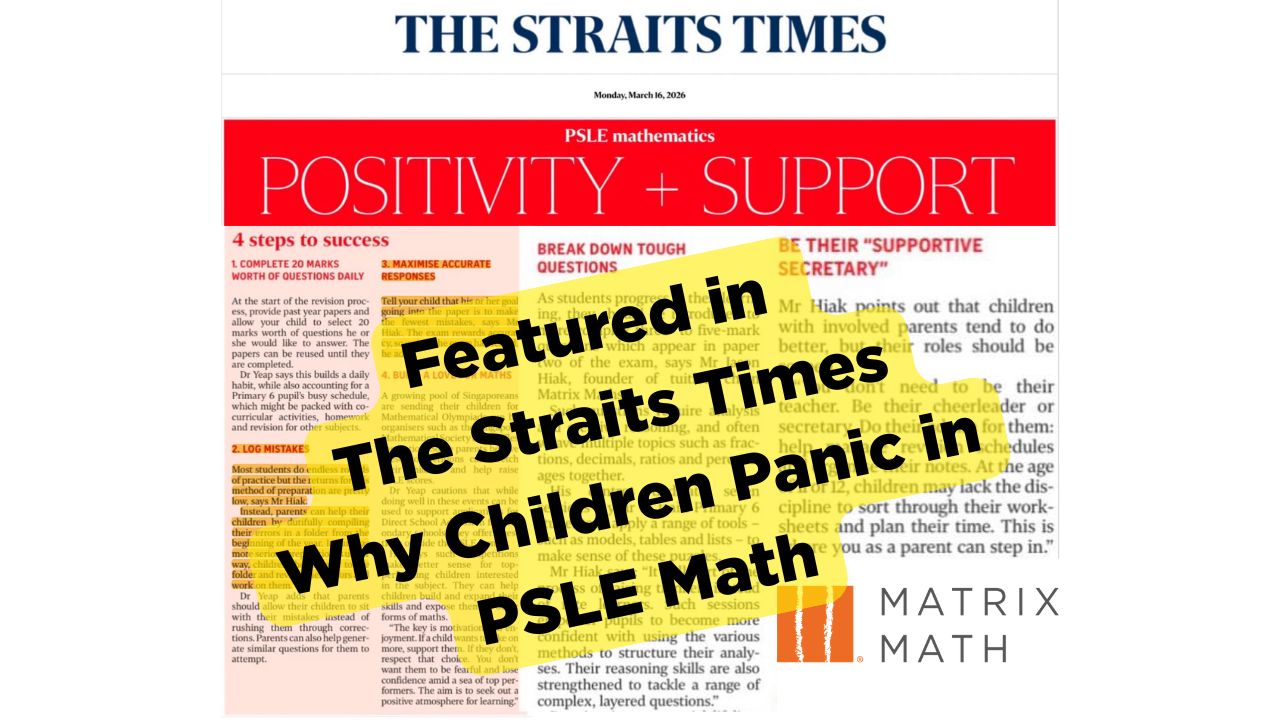
When The Straits Times recently explored why PSLE Math can trigger panic, meltdowns and self-doubt in students, the issue resonated with many parents.
The article, “Cracking the PSLE maths code: Avoid meltdowns, change mindsets,” highlighted a problem many families in Singapore already know well: a child may understand the topic, yet still struggle badly when faced with a complex, unfamiliar, multi-step PSLE Math question.
Matrix Math was featured in the article as part of this wider conversation, and the issue is one we have seen repeatedly over the years.
In working with Primary 6 students, I have seen many capable children break down not because they do not know the concepts, but because they panic when a question looks unfamiliar. Once they learn how to slow down, unpack the structure of the problem, and work through it step by step, their performance often improves significantly.
That distinction matters.
One of the biggest misconceptions parents have is this: if a child knows the concepts, the child should be able to do the paper.
That is not always true.
A child may know fractions.
A child may know ratios.
A child may know volume.
A child may know the usual methods.
But when those ideas are combined into one layered question, many students freeze.
That is why PSLE Math can feel so unforgiving. It is not simply testing whether a child has seen the topic before. It is testing whether the child can:
For some students, the issue is not content weakness. The issue is panic, poor structure, and a breakdown in thinking under stress.
After many years of working with upper primary students, one thing is clear: the gap between stronger students is often smaller than parents think.
In many cases, an AL1 student and an AL3 student may not differ very much in raw knowledge. The real difference often appears in the exam itself:
This is why simply giving a child more and more practice papers does not always solve the problem.
In fact, this is something we addressed directly on our Matrix Math YouTube channel:
YENNI EXPLAINS | Your Child Doesn’t Need More Practice Papers for PSLE Math
That video explains a hard truth many parents overlook: doing more papers without fixing the child’s thinking habits can become unproductive. The child may get more exposure, but not necessarily more clarity.
There is another uncomfortable truth.
Sometimes, the problem is not only the worksheet or the exam paper. Sometimes, the adult response around the child makes the situation worse.
When children repeatedly hear messages that increase pressure, fear, or self-doubt, they may become more fragile in front of difficult questions. They stop seeing challenge as something to work through. They start seeing it as a threat.
We discussed this in another Matrix Math YouTube video:
YENNI EXPLAINS | The Parenting Mistake That Lowers Your Child’s Grades
Parents usually mean well. But if the environment around the child becomes too tense, too reactive, or too focused on performance alone, the child’s ability to think clearly during exams can deteriorate.
That is one reason why mindset matters. Not in a motivational slogan sense, but in a practical academic sense.
A child under unnecessary emotional strain will often perform below what he or she actually knows.
The good news is that these problems are not fixed traits.
Students can be taught to become calmer, more systematic, and more resilient when facing difficult questions. Parents can support this too.
One of the most practical ways is to help the child review mistakes properly instead of simply moving on to the next worksheet.
At Matrix Math, we have produced a free parent guide on how families can help children learn from mistakes more effectively. This is directly related to the same issue discussed in The Straits Times: many children keep repeating the same types of errors because there is no proper process for reviewing what went wrong.
Common repeated mistakes include:
Without a system for reflection, practice alone can become shallow. The child keeps doing more, but does not really improve the underlying habits.
A mistake log helps shift the focus from “How many questions did you do?” to “What exactly went wrong, and how do we stop this from happening again?”
That is a much more intelligent way to improve.
Download the free guide here:
How Parents Can Help Their Children Learn From Mistakes
At Matrix Math, we do not believe that PSLE Math success comes from brute-force drilling alone.
Students need content mastery, yes. But beyond that, they need to develop the thinking habits required for higher-order problem solving.
That includes learning how to:
This is why the public conversation raised by The Straits Times matters. It helps parents see that a child’s struggle in Math is not always a simple matter of “not studying enough”.
Sometimes the child needs a better process.
Sometimes the child needs better emotional handling.
Sometimes the child needs more deliberate correction of repeated mistakes.
Sometimes the child needs to be taught how to think, not just what to do.
To support parents further, we have created related resources connected to the same issues raised in the Straits Timesdiscussion.
These are directly related to the same real issue: helping children handle challenge better, reduce repeated mistakes, and approach PSLE Math in a more productive way.
Matrix Math is a Singapore Math tuition programme aligned with the MOE syllabus. We focus on helping students build strong understanding, structured reasoning, and greater confidence in handling challenging Math questions at the Primary and Secondary levels.
Our approach is not just about getting through worksheets. It is about helping students think more clearly, make fewer repeated mistakes, and become more composed problem solvers.
Looking for a structured PSLE Math programme that helps students build confidence in challenging problem sums?
Explore Matrix Math’s resources or contact us to learn more about our classes, teaching approach, and support for Primary and Secondary Math students.
A difficult PSLE Math question does not always reveal a lack of ability.
Very often, it reveals something else:
These can be worked on.
That is why the conversation raised in The Straits Times matters. It pushes parents to look deeper than marks alone and ask a better question:
What exactly is causing my child to struggle, and what kind of support will actually help?
That is the question worth solving.