
For Primary 1 to Primary 6, at 12 Matrix Math® centres across Singapore
Primary math tuition in Singapore
Many children calculate well but get stuck on problem sums. For 18 years, our classes have taught heuristic math, model drawing and the Matrix Method, so children can reason through a question on their own, from Primary 1 to PSLE Math. Our own R&D team keeps the programme in step with how school and PSLE papers are set.
Trial lesson $70 nett
or WhatsApp +65 9722 7759
A problem sum, drawn as a model
John has 3 times as many stickers as Peter. After John gives Peter 24 stickers, they have the same number. How many stickers did John have at first?
After the gift, both have 2 units, so John gave away 1 unit.
1 unit = 24 stickers
John at first = 3 units = 3 × 24 = 72
John had 72 stickers at first.
Why primary math gets harder every year
In lower primary, most questions are straight calculation. From Primary 3, problem sums get longer and take more steps, and by Primary 6 the PSLE Math paper rewards children who can plan their own approach. These are the three changes children most often struggle with. You can also read why scoring above 90 marks in PSLE Math is so difficult.
Problem sums test reading, not just calculating
A problem sum describes a situation in words. Your child has to decide which numbers matter, how they are related and which operation to use, before any calculation starts.
Challenging math questions are non-routine
Higher-order questions are written so they do not look like the textbook examples. Memorised steps stop working, and children need problem solving skills to find an approach from the concept itself.
Every year builds on the last
Fractions from Primary 2 to 4 become ratio and percentage in Primary 5 and 6. A gap left in an early topic usually shows up later, in a harder question.
18 years, and an R&D team behind every lesson
Matrix Math® has delivered primary math tuition for 18 years. Our programme is written by our own R&D team of teachers, not taken from an off-the-shelf assessment book.
Exam papers change from year to year, in the question types they use and how questions are worded. Our R&D team’s job is to spot these changes early and build them into what your child learns. Download the 2025 top school papers we share with parents.
The Matrix Method: five steps for problem sums
We have refined the Matrix Method since 2008. It sorts heuristic problem sums into types, and gives children one thought process to use on every type. That means fewer tricks to memorise and a clear place to start when a question looks unfamiliar.
Here are the five steps, applied to the sticker question above.
Record the data
Write down what the question gives, as units.
In the example: John is 3 units, Peter is 1 unit.
Establish a common base
Find what stays the same, so the before and after can be compared.
In the example: The total, 4 units, does not change.
Identify the value
Match the number in the question to its units.
In the example: After the gift both have 2 units, so the 24 stickers John gave are 1 unit.
Solve 1 unit
Work out the value of one unit.
In the example: 1 unit = 24 stickers.
Read the question again
Check what is asked before writing the answer.
In the example: John at first: 3 units = 72 stickers.
What happens in our primary math tuition classes
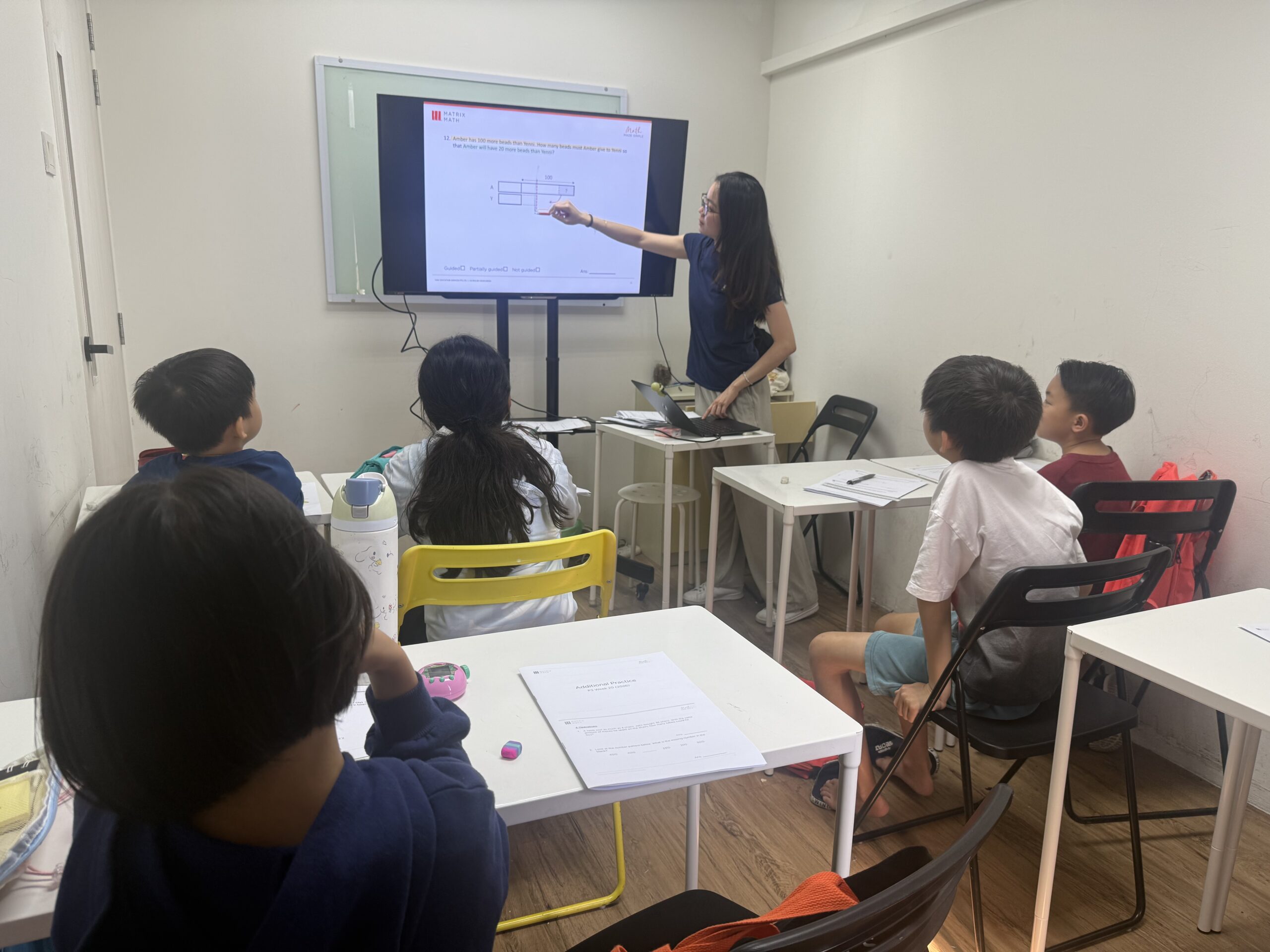
Every lesson follows the MOE syllabus in the order your child meets it in school, and every lesson works on problem solving skills, not just topic content.
Our teachers are trained in the Matrix Method and know the current syllabus well. They teach children how to think through a question, not just how to reach the answer.
Primary math tuition by level
Each level covers the topics your child is learning in school that year. For the full topic list, see our guide to the MOE primary math syllabus.
Primary 1 math tuition
Numbers to 100, addition and subtraction, and a first look at multiplication and division. The focus is number sense and careful, neat working.
See the Primary 1 programmePrimary 2 math tuition
Numbers to 1,000, the 2, 3, 4, 5 and 10 times tables, money, and first fractions. Children start drawing simple models for word problems.
See the Primary 2 programmePrimary 3 math tuition
Numbers to 10,000, the 6 to 9 times tables, equivalent fractions, area and perimeter, and bar graphs. Problem sums start to take several steps.
See the Primary 3 programmePrimary 4 math tuition
Factors and multiples, mixed numbers, fractions of a set, decimals and angles. Heuristic problem sums such as before-and-after become a regular part of school tests.
See the Primary 4 programmePrimary 5 math tuition
Percentage, rate, area of triangles and volume, with longer fraction and decimal problem sums. These topics are tested directly in PSLE Math.
See the Primary 5 programmePrimary 6 and PSLE Math tuition
Ratio, algebra, circles, percentage change and average, then PSLE Math revision with exam-style questions and mock exams.
See the Primary 6 and PSLE programmeFree notes and exam papers
Printable notes written by our teachers, and 2025 papers from top primary schools. Free to download, no sign-up needed.
Revision notes
Short notes on the concepts and problem sums that come up most often.
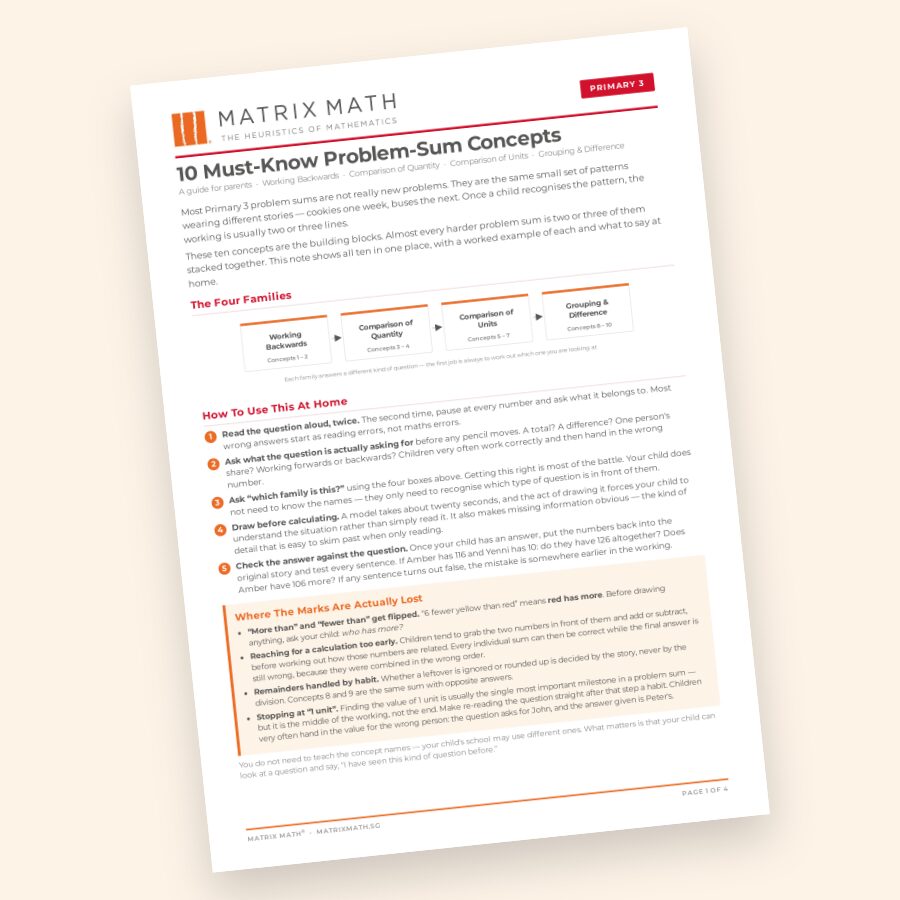
10 must-know problem-sum concepts
Primary 3. The ten building blocks behind most Primary 3 problem sums, each with a worked example and model drawing. PDF, 8 pages.
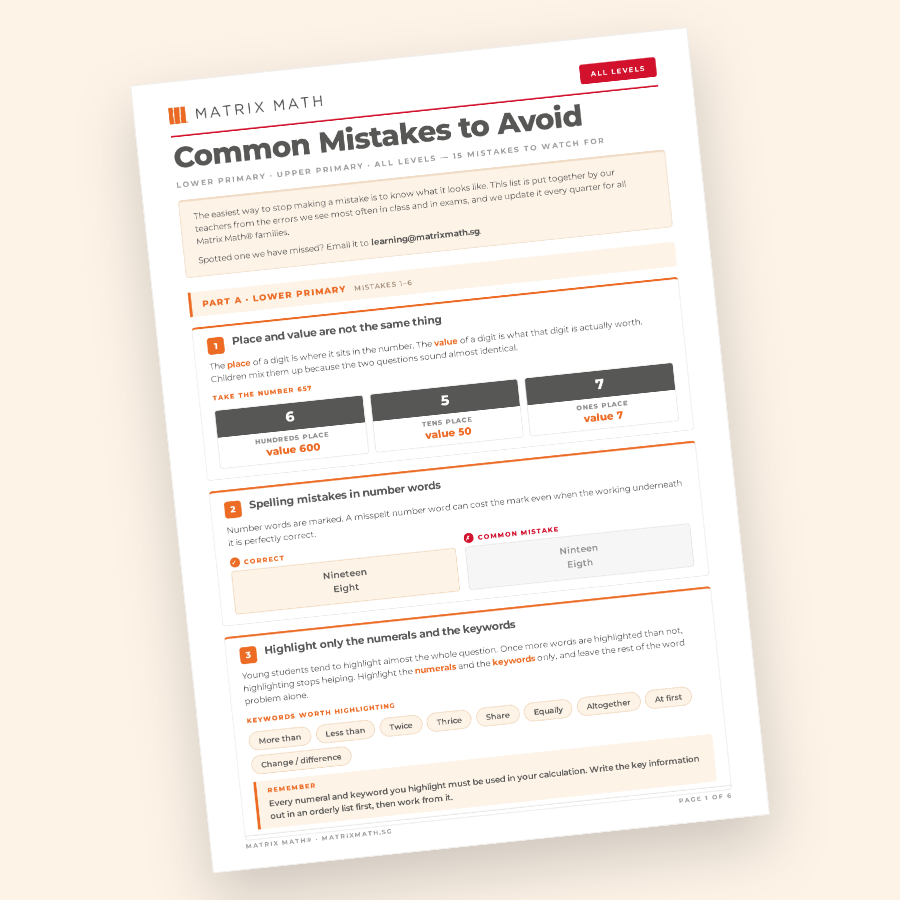
Common mistakes to avoid
Primary 1 to 6. The mistakes students make most often in exams, from place value to fractions. PDF, 6 pages.
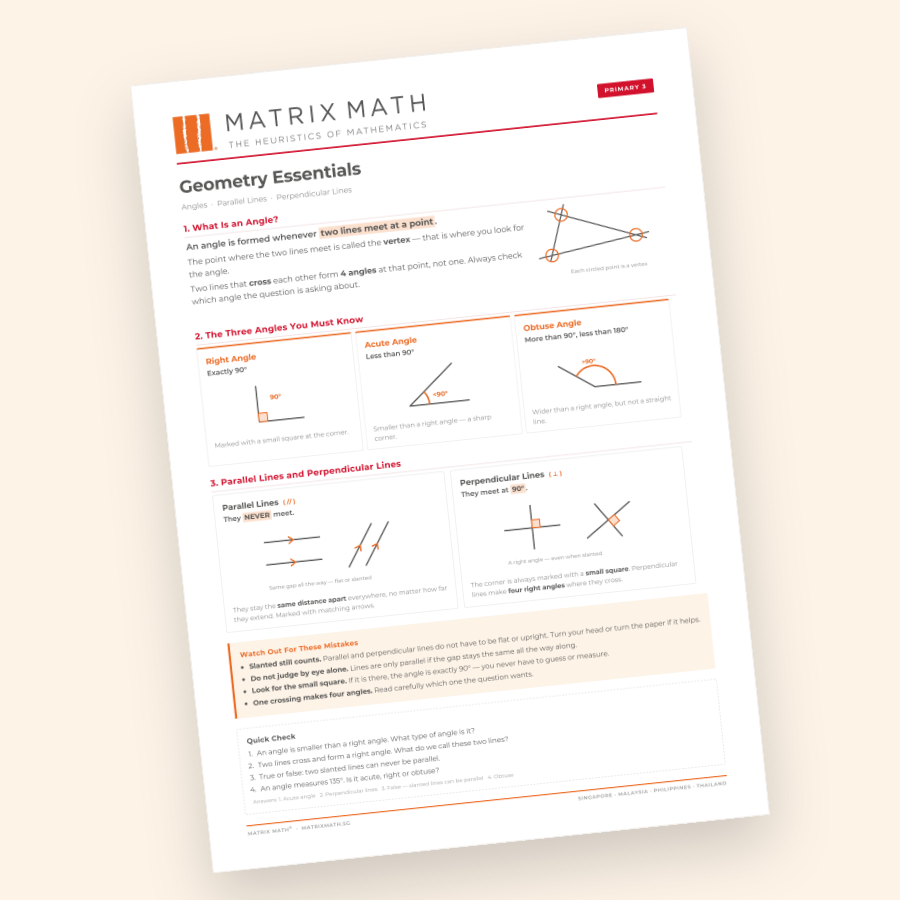
Geometry essentials
Primary 3. The angle and shape facts every Primary 3 pupil needs, on one page. PDF, 1 page.
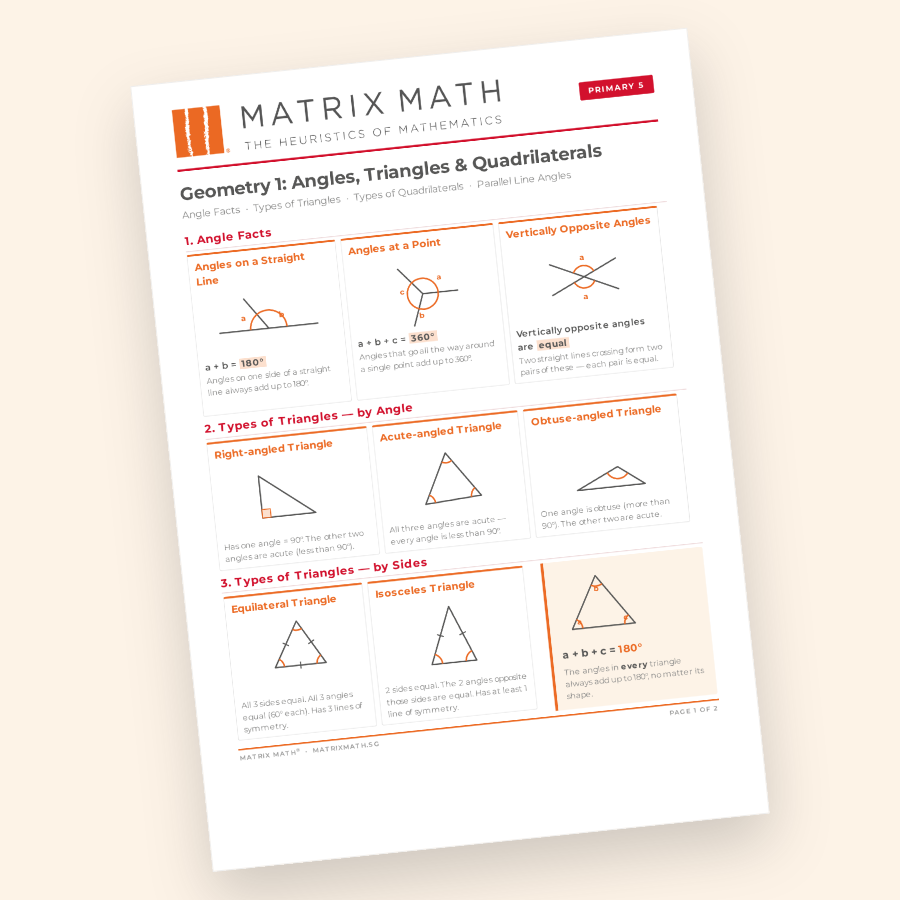
Angles, triangles and quadrilaterals
Primary 5. Angle facts, triangle and quadrilateral properties, and the parallel-line angle rules. PDF, 2 pages.
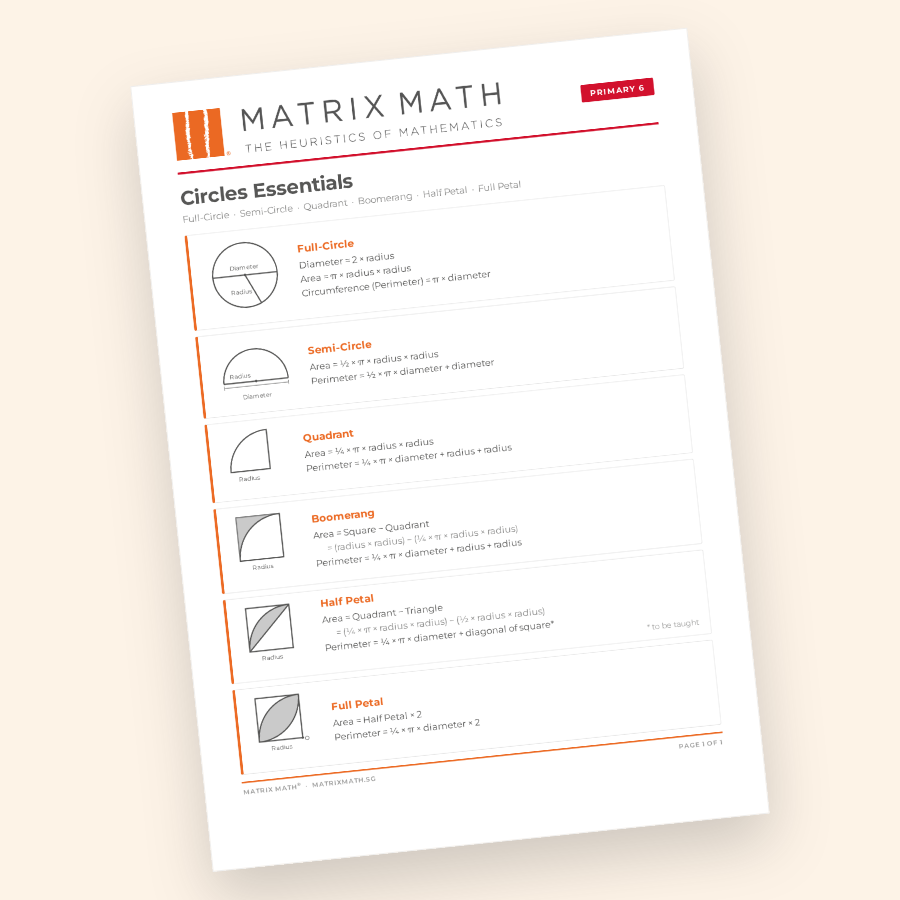
Circles essentials
Primary 6. Radius, diameter, circumference and area, plus the semicircles and quarter circles common in PSLE questions. PDF, 2 pages.
2025 top school exam papers
Practice papers for Primary 2 to Primary 6.
Primary 2 top school papers
2025 exam papers from leading primary schools. PDF.
Primary 3 top school papers
2025 exam papers from leading primary schools. PDF.
Primary 4 top school papers
2025 exam papers from leading primary schools. PDF.
Primary 5 top school papers
2025 exam papers from leading primary schools. PDF.
Primary 6 prelim papers
2025 preliminary exam papers from leading primary schools, for the final stretch before PSLE. PDF.
Our teachers solve questions from these papers on video, using the Matrix Method. Watch the solutions on YouTube, or get new videos on our WhatsApp channel.
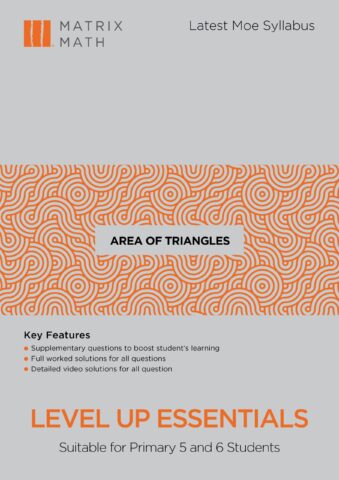
Level Up Essentials: Area of Triangles
A 40-page practice book for Primary 5 and 6 on one of the most tested geometry topics. Questions are grouped by concept and move from basic to exam level. Every question comes with a full worked solution and a step-by-step video.
$38, including the book and all solutions. WhatsApp us to order, or see the Level Up Essentials series.
Questions parents ask
Anything else? WhatsApp us on +65 9722 7759.
What is heuristic math?
Heuristics are problem-solving strategies, such as drawing a model, making a list, guess and check, looking for patterns and working backwards. They are part of the MOE primary math syllabus. Heuristic math means teaching children to recognise which strategy a problem sum needs, instead of hoping they spot it in the exam.
What is model drawing, and why does it matter?
Model drawing turns a word problem into bars, so the relationship between the quantities is easy to see. It is the standard way to solve many Singapore primary math problem sums, from simple comparisons in lower primary to fraction, ratio and percentage questions in PSLE Math.
When should my child start primary math tuition?
Any level can work, as long as gaps are fixed before they build up. Primary 3 and 4 are important years: fractions, decimals and multi-step problem sums start here, and the PSLE topics in Primary 5 and 6 build directly on them.
How do you prepare Primary 6 students for PSLE Math?
Primary 6 classes cover the remaining syllabus topics, then move to PSLE Math revision: exam-style questions, mock exams and practice in planning time across both papers. The Matrix Method gives students a consistent way to start on unfamiliar questions.
How much is a trial lesson?
A trial lesson is $70 nett. If your child enrols within 7 days of the trial, the $70 counts as payment for the first lesson.
What parents say
Reviews of Matrix Math® centres on Google.