
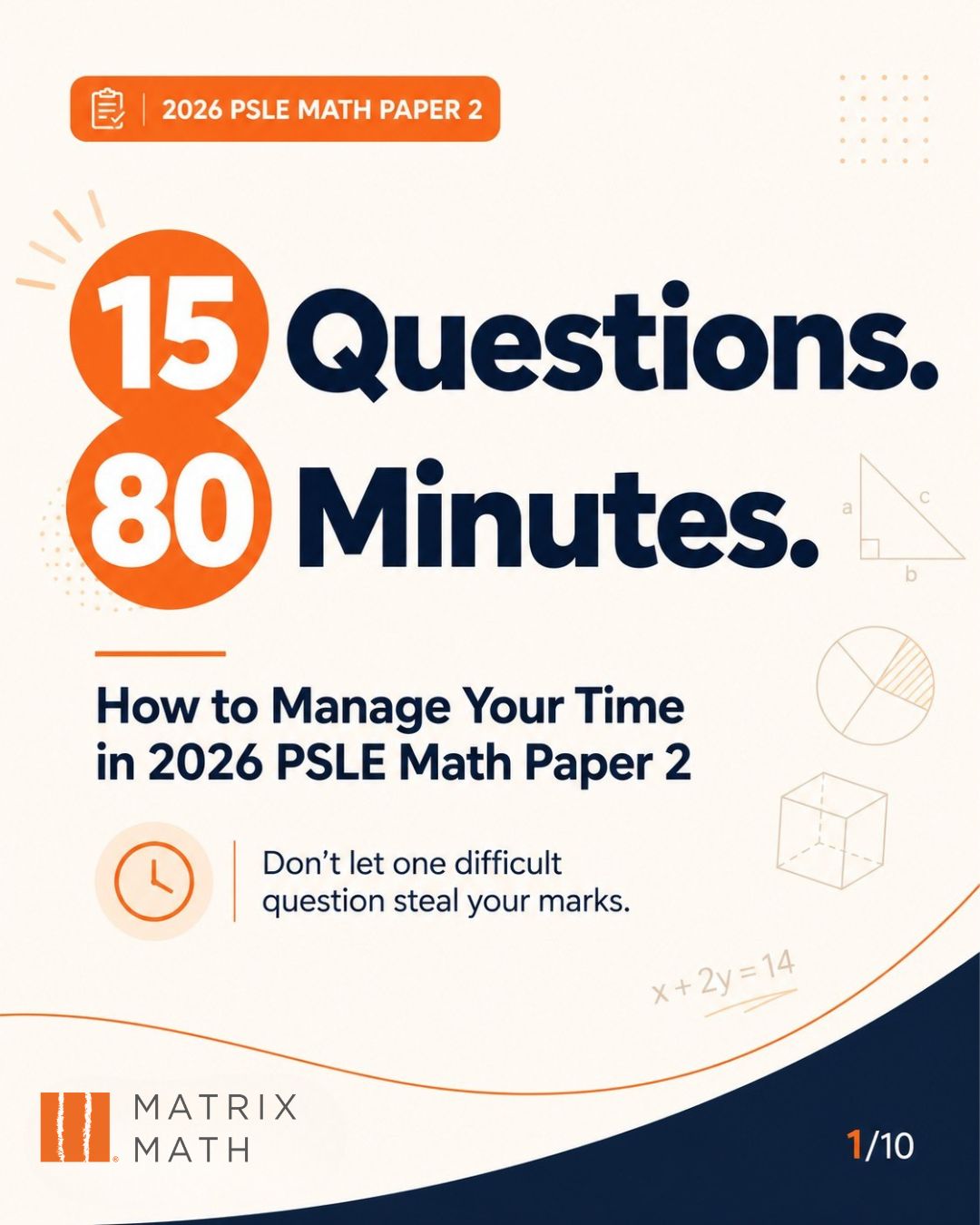
Every year, capable students lose marks in PSLE Math Paper 2 — not because they cannot solve the questions, but because they run out of time. One difficult question eats fifteen minutes, and three easier questions go unanswered. The maths was never the problem. The clock was.
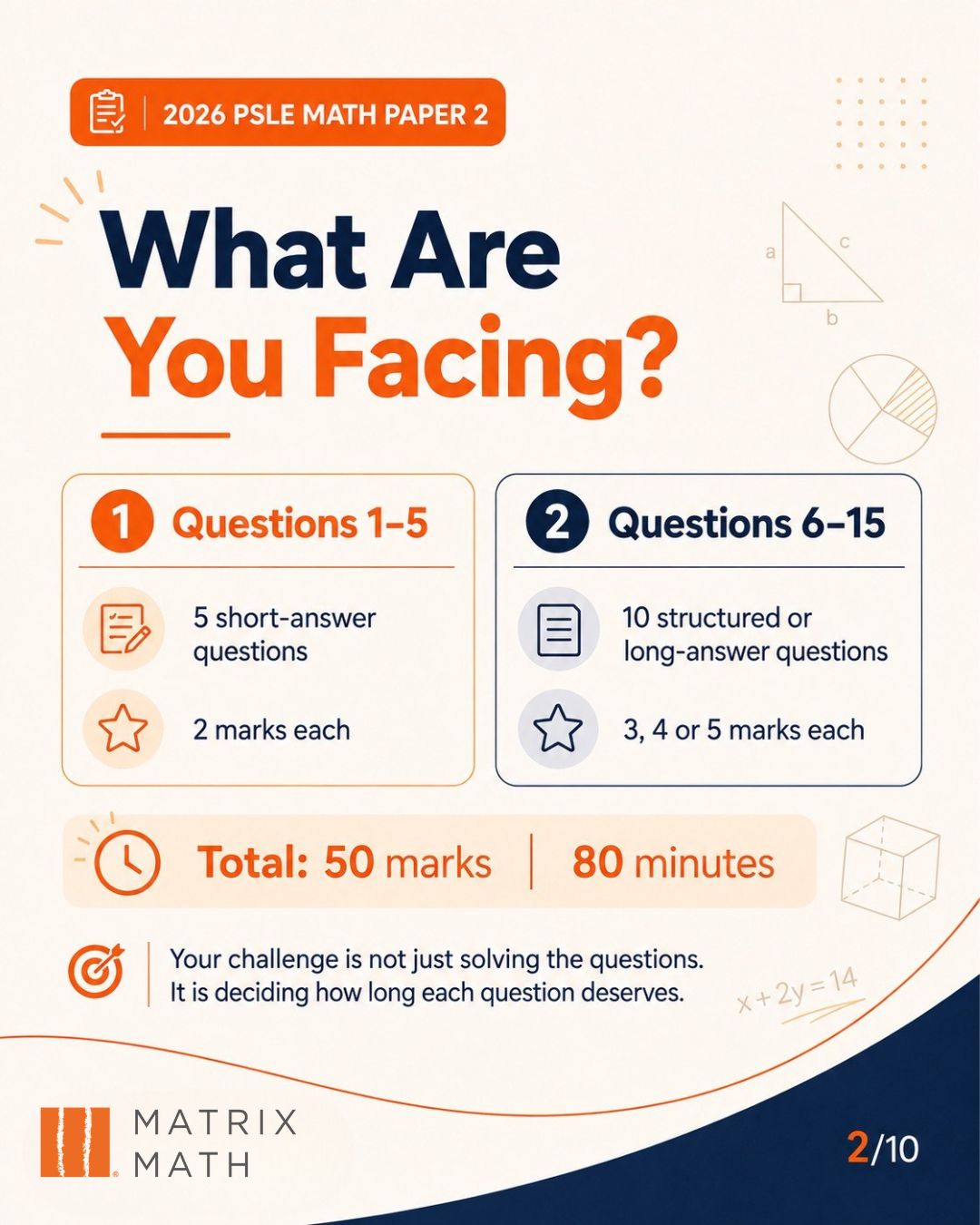
From 2026, PSLE Mathematics Paper 2 carries 50 marks and runs for 1 hour 20 minutes. It contains 15 questions: five short-answer questions worth 2 marks each, followed by ten structured or long-answer questions worth 3, 4 or 5 marks each. A calculator is allowed. The challenge is no longer only how to solve each question — it is deciding how long each question deserves.
At Matrix Math®, we teach students a simple timing plan they can practise before the exam, so managing the clock becomes automatic on the day. Swipe through the guide below, then read our breakdown underneath.
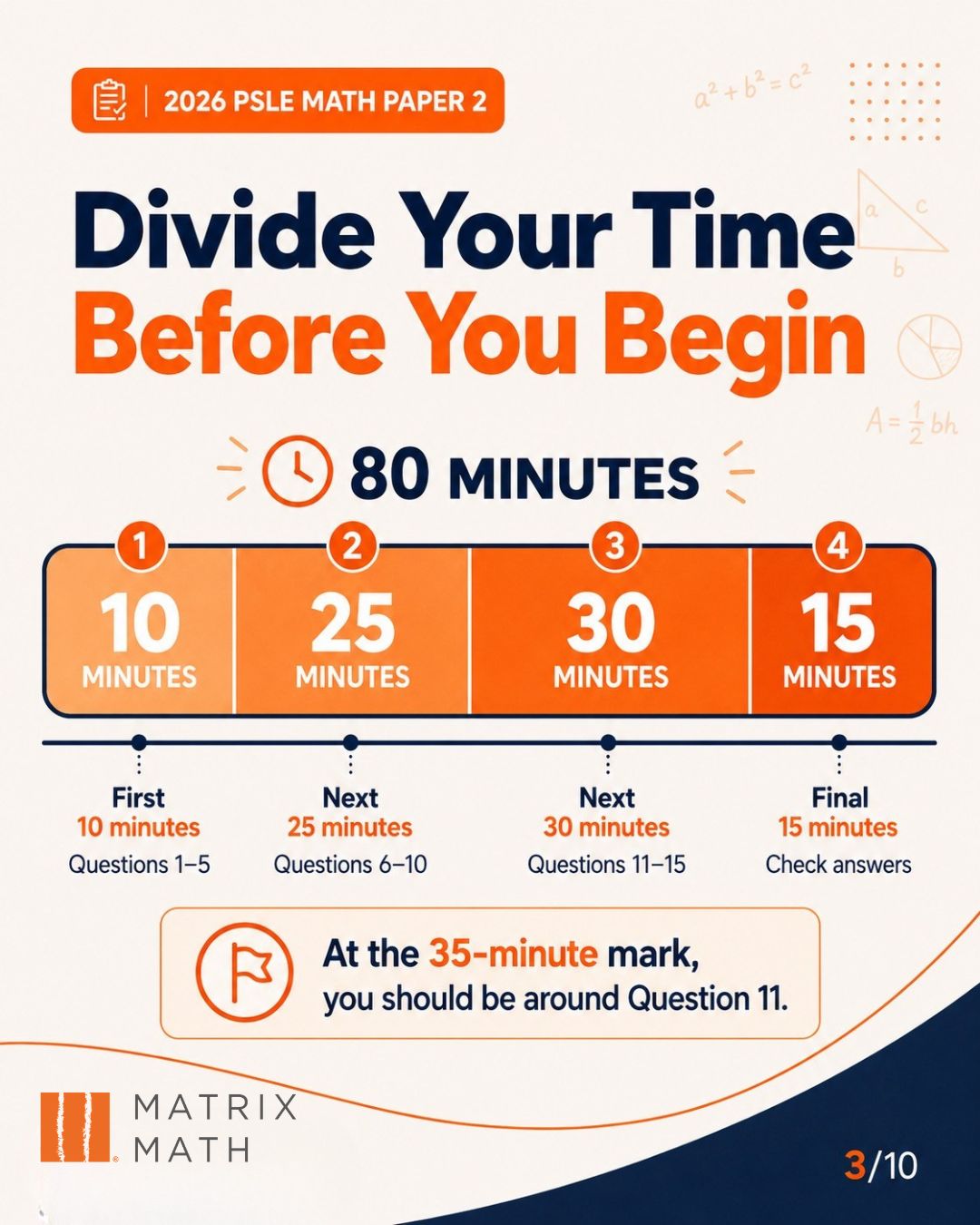
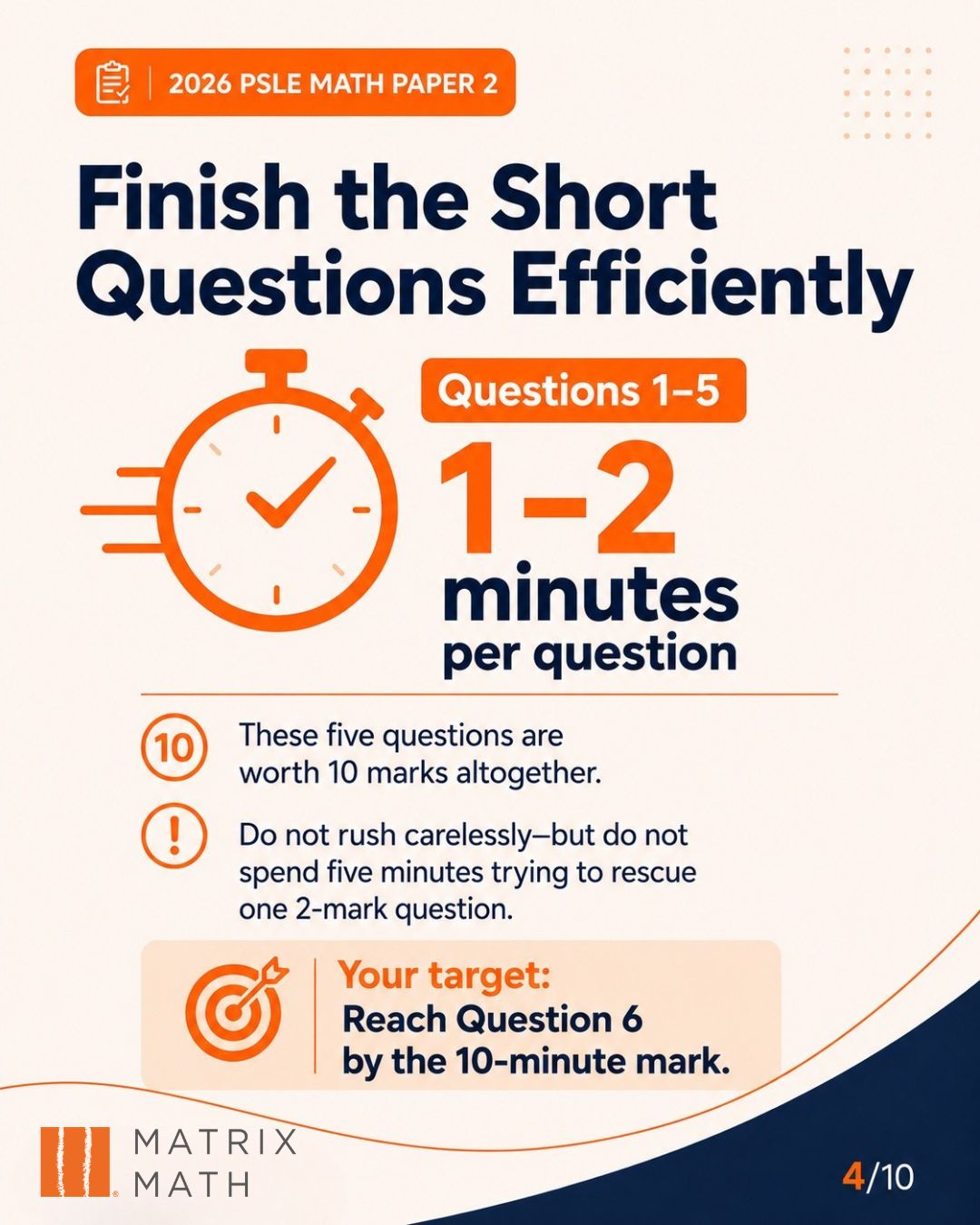
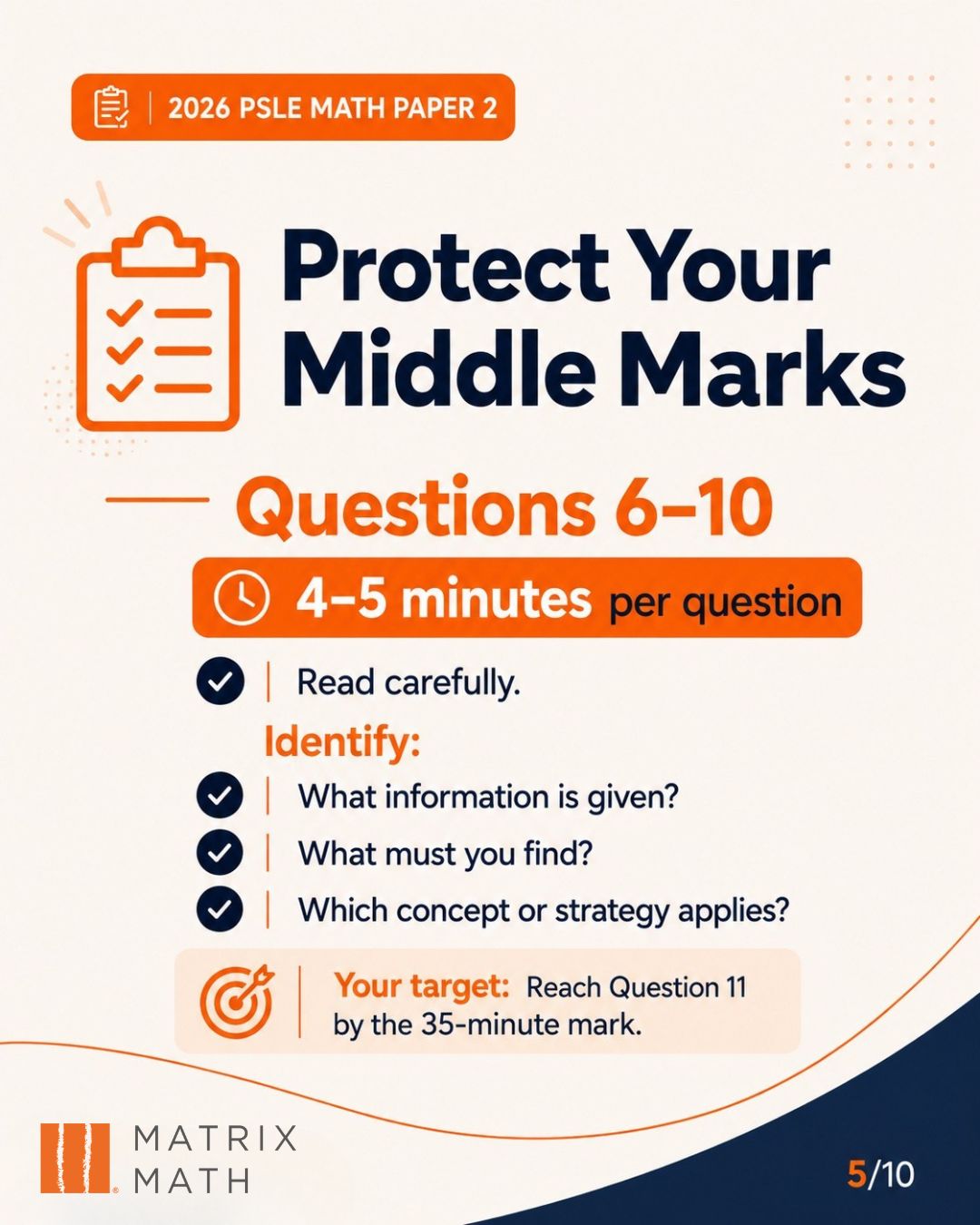
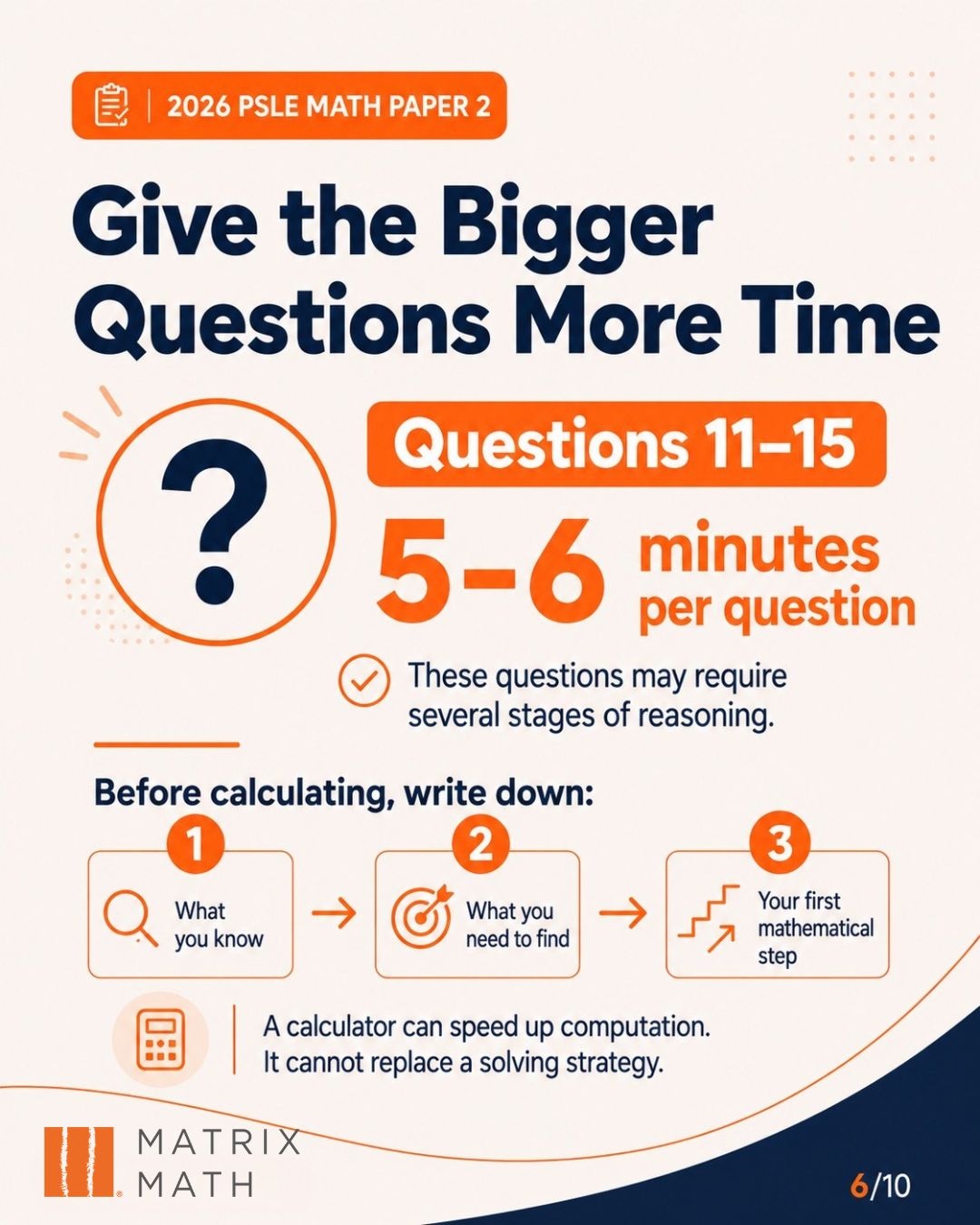
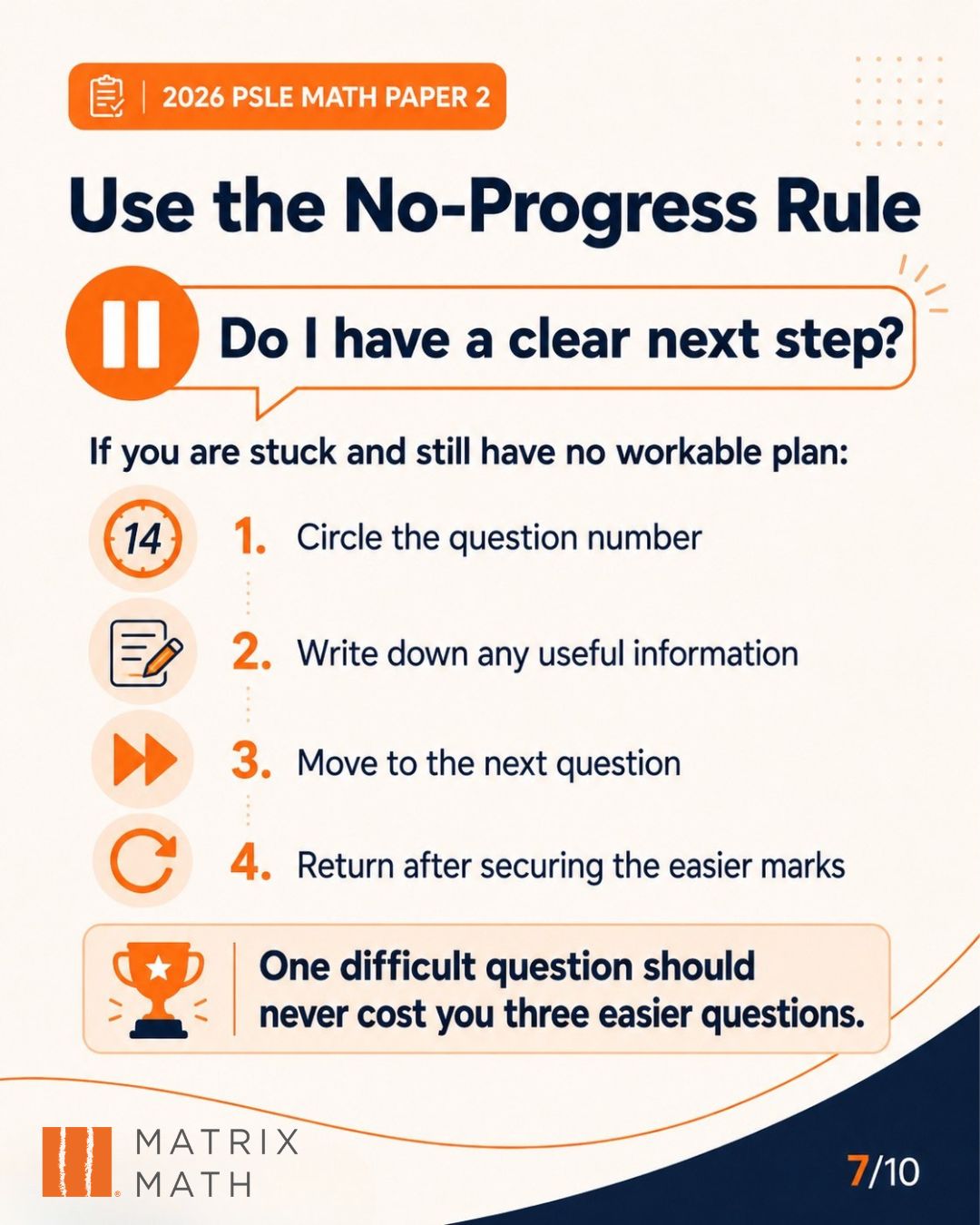
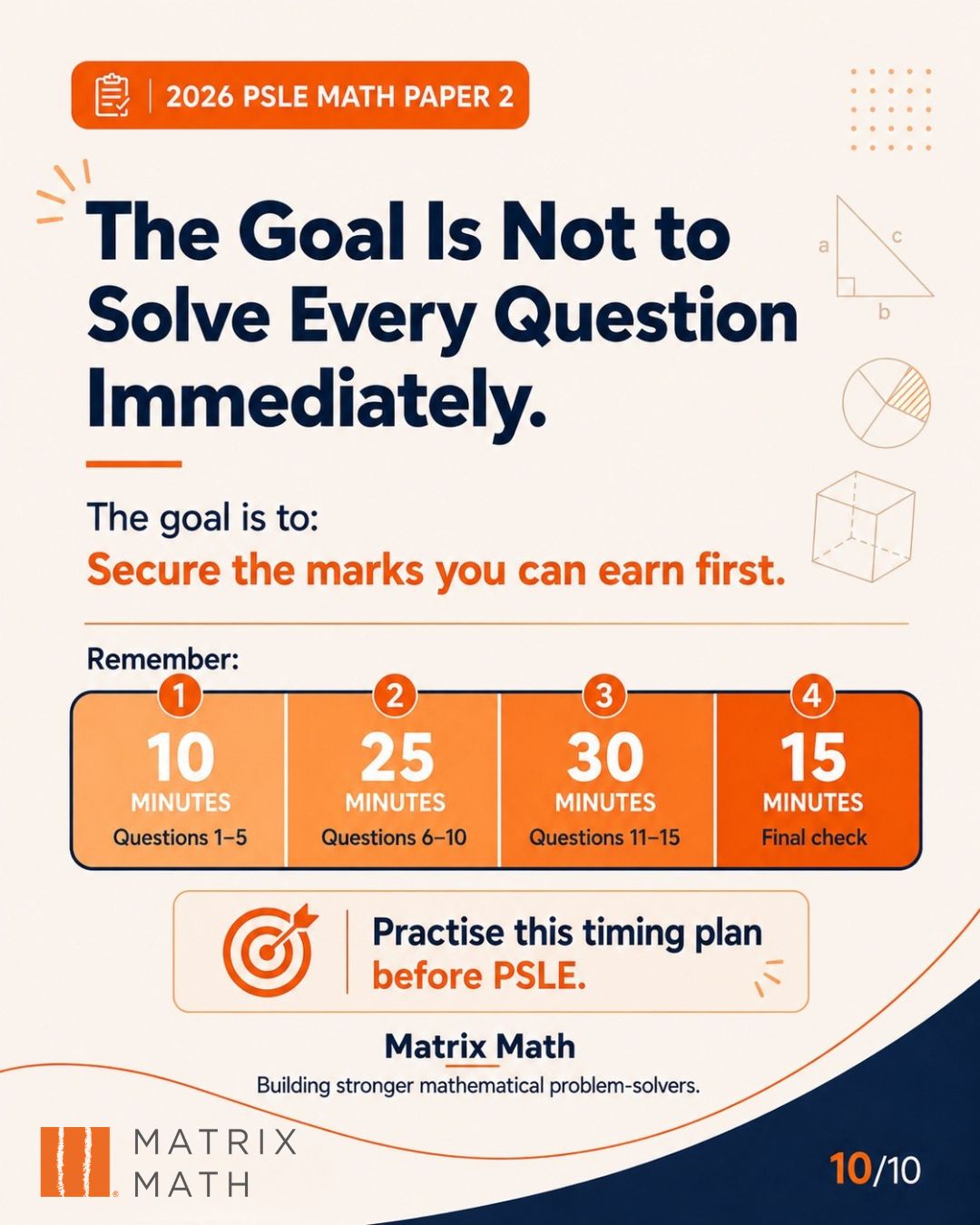
The whole plan fits into four blocks across the 80 minutes. The goal is not to solve every question immediately — it is to secure the marks your child can earn first, then return to the harder ones.
These five short-answer questions are worth 10 marks in total, roughly 1 to 2 minutes each. They are the fastest marks on the paper. The aim is to reach Question 6 by the 10-minute mark. Do not rush carelessly, but do not spend five minutes rescuing a single 2-mark question either.
These are the middle-mark questions, around 4 to 5 minutes each. For each one, read carefully and identify three things before solving: what information is given, what you must find, and which concept or strategy applies. The target is to reach Question 11 by the 35-minute mark.
These larger questions may need several stages of reasoning, so they deserve 5 to 6 minutes each. Before calculating, write down what you know, what you need to find, and your first mathematical step. A calculator speeds up computation — it does not replace a solving strategy.
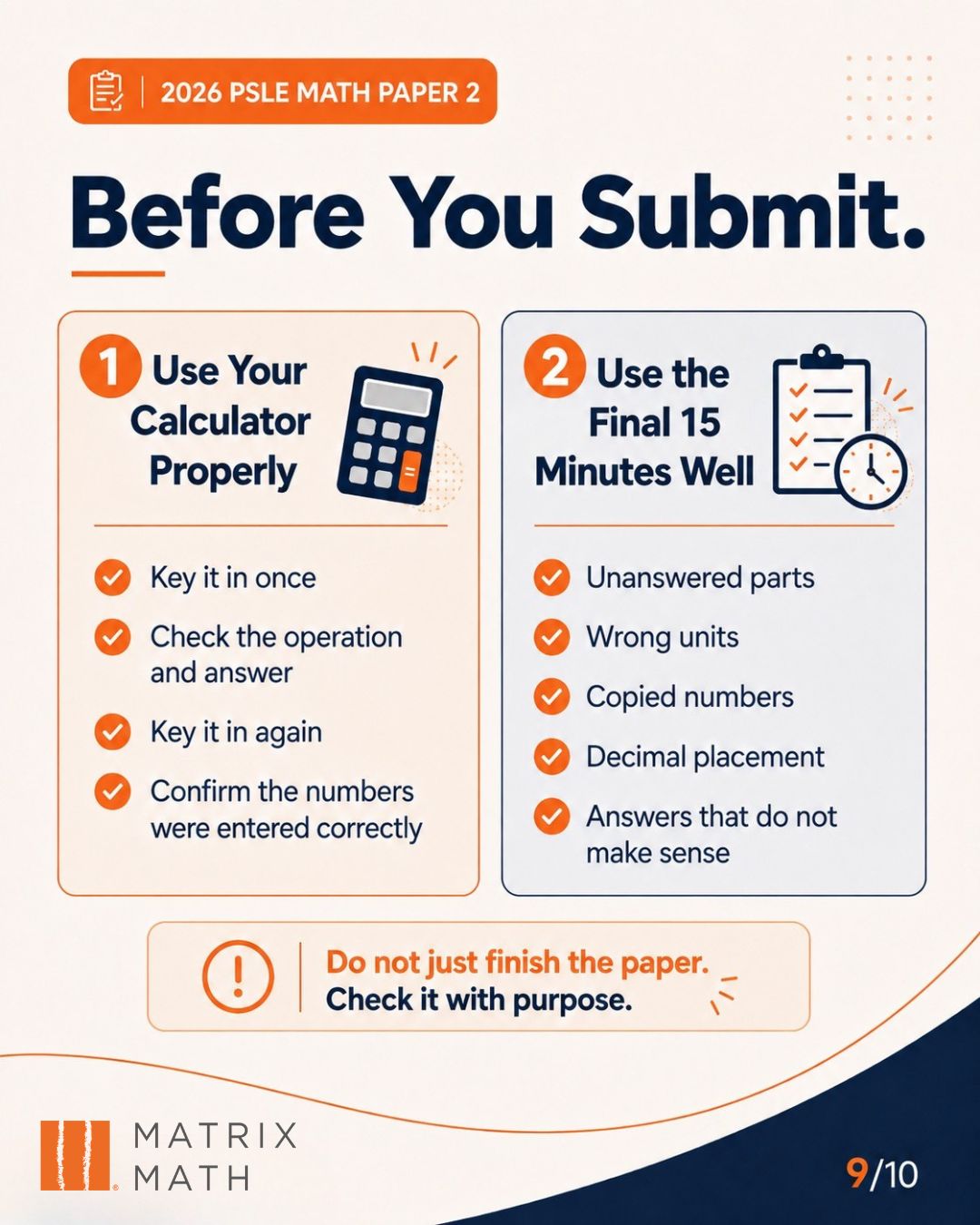
Use the last stretch deliberately. Look for unanswered parts, wrong units, copied numbers, misplaced decimals, and answers that simply do not make sense. When using the calculator, key it in once, check the operation and answer, then key it in again to confirm. Do not just finish the paper — check it with purpose.
The no-progress rule. If your child is stuck with no workable plan, they should circle the question number, jot down any useful information, move on to the next question, and return after securing the easier marks. One difficult question should never cost three easier ones.
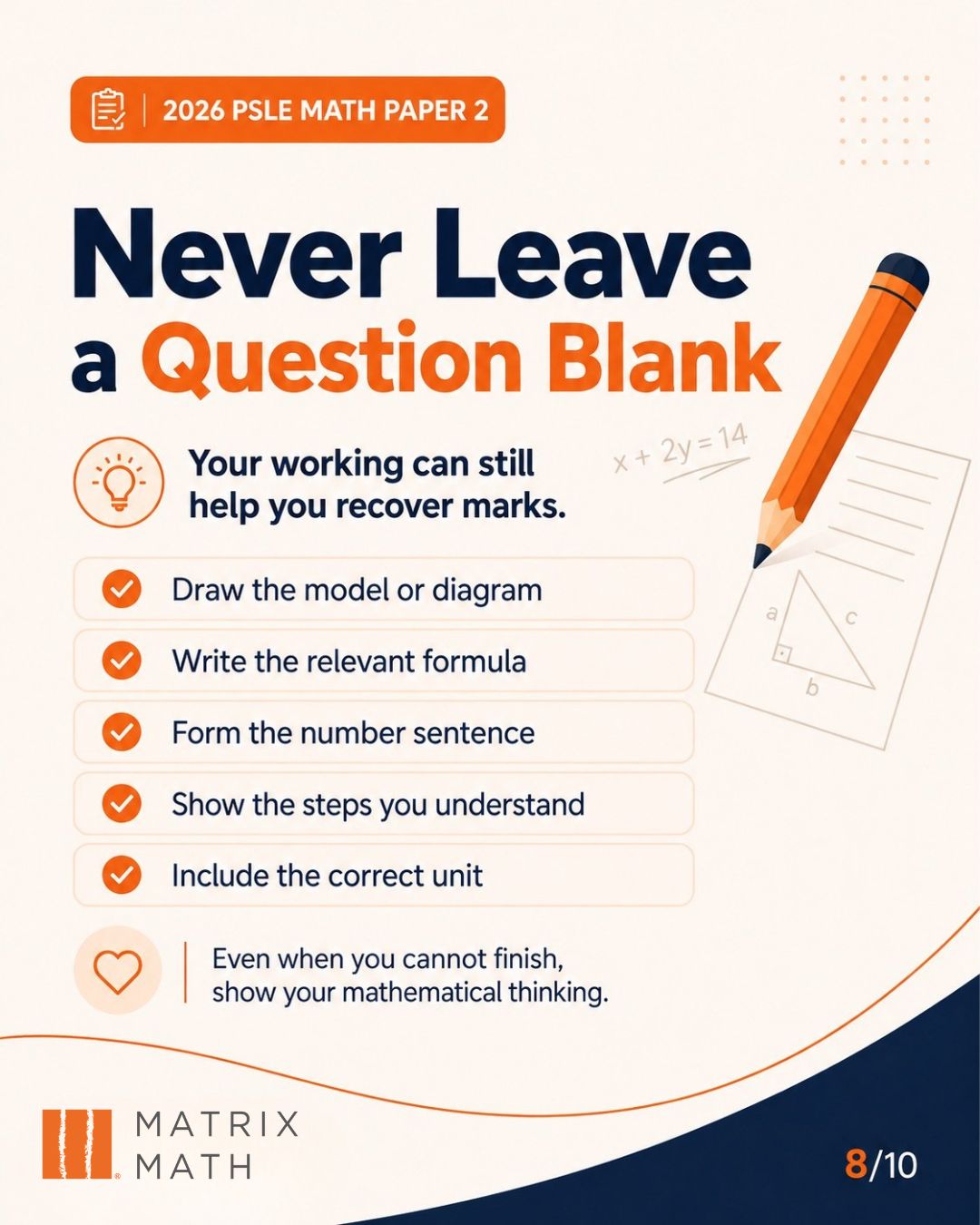
Never leave a question blank. Working still earns marks. Drawing the model or diagram, writing the relevant formula, forming the number sentence, and including the correct unit can all recover partial credit — even when the final answer never arrives. The habit is simple: always show your mathematical thinking.
Timing is a skill, not a talent. A student who practises this plan across a few timed papers walks into the exam hall already knowing the rhythm of the paper. That composure is often the difference between a child who finishes calmly and one who panics at Question 12.
At Matrix Math®, our students learn the Matrix Method™ — the heuristics that solve commonly-tested problem sums — alongside exam habits like this timing plan, so they are prepared for both the mathematics and the moment.
For parents searching for the best math tuition to prepare their child for PSLE, exam technique like this timing plan is what separates a strong programme from the rest — and it is exactly what we build into every Matrix Math® class, lesson after lesson.
Want your child to master timing and the Matrix Method™?
Learn More