20 July 2026
Many students assume that getting the final answer correct is all that matters in PSLE Mathematics. That is only partly true.
For some questions, only the final answer is considered. For structured and long-answer questions, however, students may still earn marks for using the correct method, even when they make a calculation mistake later.
Understanding how marks are awarded can help students present their working more clearly and avoid losing marks unnecessarily.
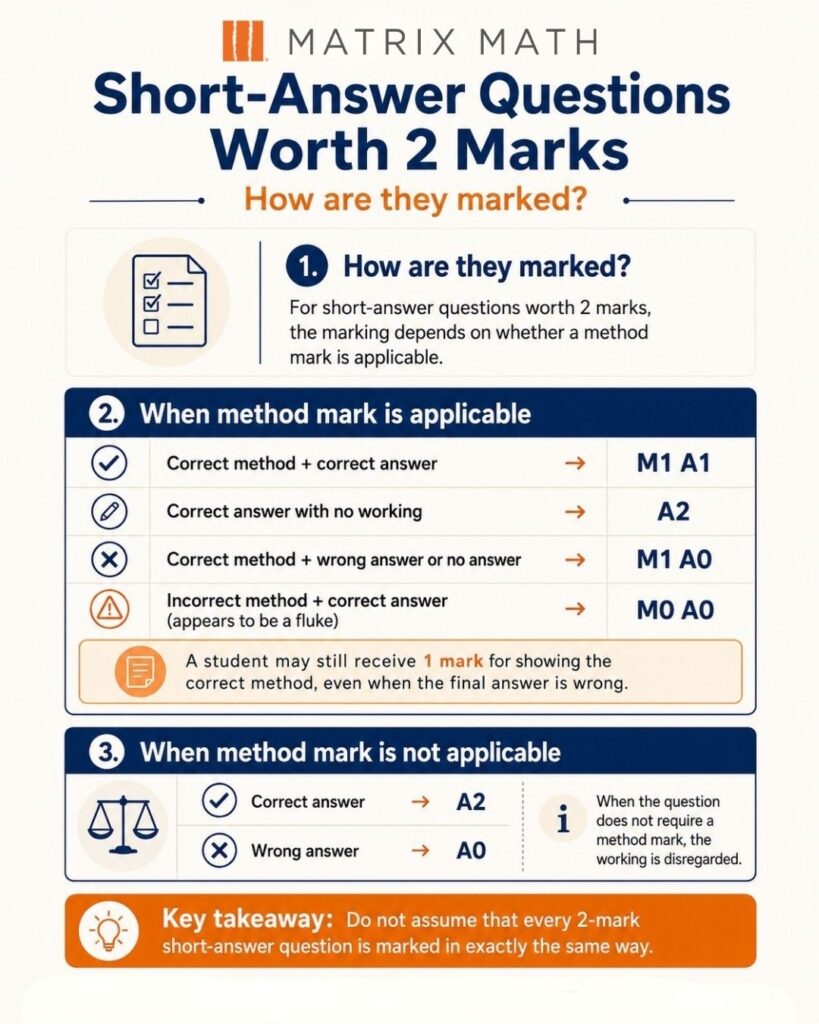
For short-answer questions worth 2 marks, the marking depends on whether a method mark is applicable.
When both method and answer marks are applicable:
A student may therefore still receive 1 mark for showing the correct method, even when the final answer is wrong.
However, when the question does not require a method mark, the working is disregarded.
The important lesson is that students should not assume that every 2-mark short-answer question is marked in exactly the same way.
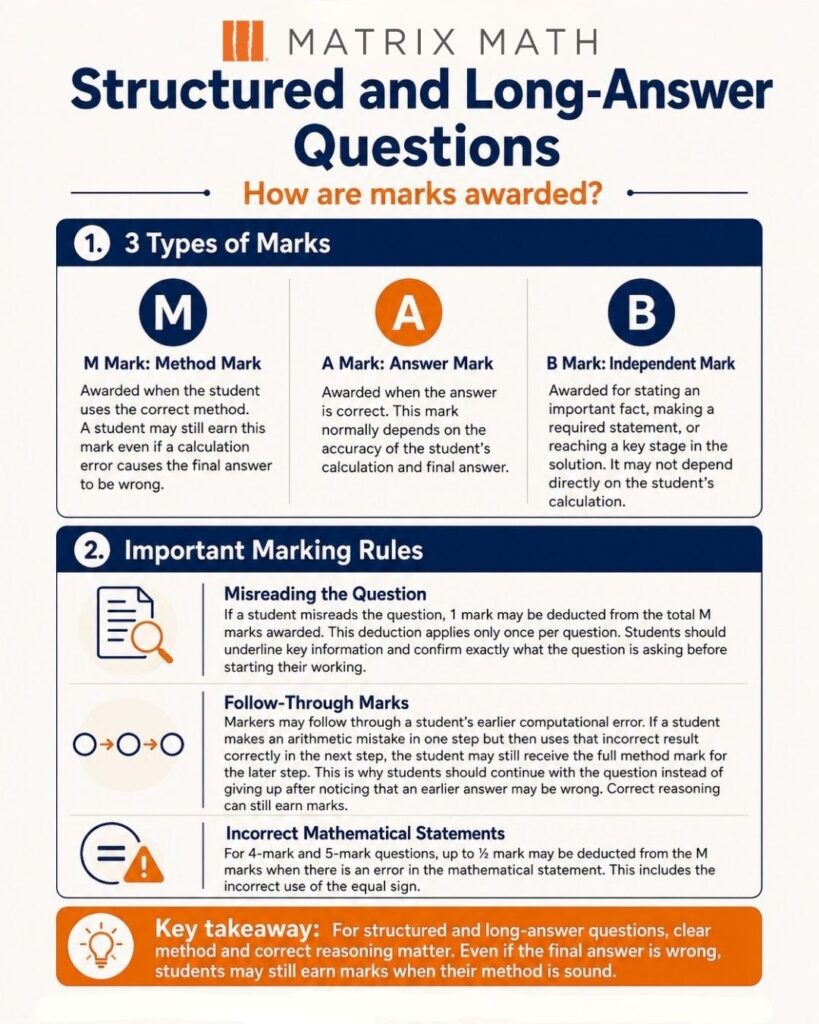
Structured and long-answer questions may contain three types of marks.
An M Mark is awarded when the student uses the correct method.
The student may still earn this mark even if a calculation error causes the final answer to be wrong.
An A Mark is awarded when the answer is correct.
This mark normally depends on the accuracy of the student’s calculation and final answer.
A B Mark is awarded for stating an important fact, making a required statement or reaching a key stage in the solution.
It may not depend directly on the student’s calculation.
If a student misreads the question, 1 mark may be deducted from the total M marks awarded.
This deduction also applies only once per question.
Students should underline key information and confirm exactly what the question is asking before starting their working.
Markers may follow through a student’s earlier computational error.
For example, if a student makes an arithmetic mistake in one step but then uses that incorrect result correctly in the next step, the student may still receive the full method mark for the later step.
This is why students should continue with the question instead of giving up after noticing that an earlier answer may be wrong.
Correct reasoning can still earn marks.
For 4-mark and 5-mark questions, up to ½ mark may be deducted from the M marks when there is an error in the mathematical statement.
This includes the incorrect use of the equal sign.
For example:
Incorrect:
8 × 5 = 40 ÷ 2 = 20
The equal sign is being used incorrectly because 8 × 5 is not equal to 40 ÷ 2.
Better:
8 × 5 = 40
40 ÷ 2 = 20
Students should write each mathematical statement clearly and accurately.
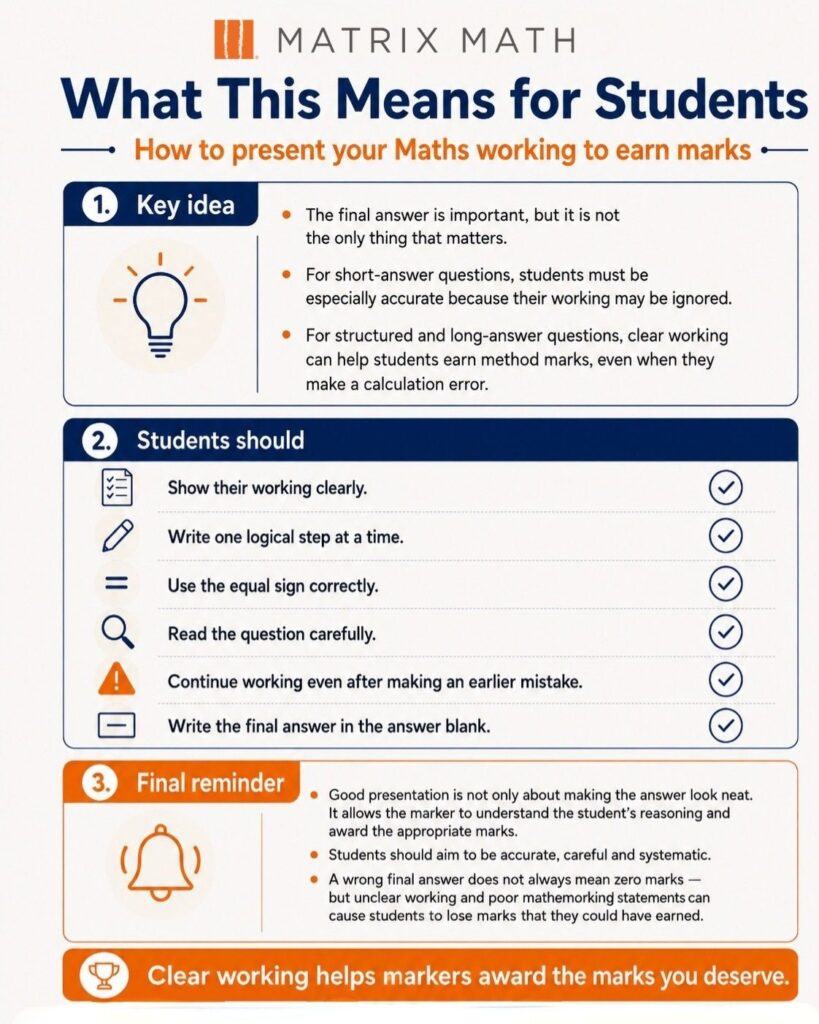
The final answer is important, but it is not the only thing that matters.
For short-answer questions, students must be especially accurate because their working may be ignored.
For structured and long-answer questions, clear working can help students earn method marks, even when they make a calculation error.
Students should:
Good presentation is not only about making the answer look neat. It allows the marker to understand the student’s reasoning and award the appropriate marks.
Students should aim to be accurate, careful and systematic.
A wrong final answer does not always mean zero marks—but unclear working and poor mathematical statements can cause students to lose marks that they could have earned.