
Every year around November, we get the same question from K2 parents: "Is my child ready for Primary 1?" Some have heard that other children are already doing addition and subtraction. Others are wondering if they should buy assessment books over the December holidays.
After 18 years of teaching maths at Matrix Math®, here is our honest answer. Most children are more ready than their parents think. But there are a few specific gaps that do cause trouble in the first year, and they are not always the ones parents expect.
What MOE actually expects
The bar is lower than most parents assume. For maths, MOE says children entering Primary 1 should be able to count up to 10 and understand ideas like "more", "less" and "the same" (Schoolbag, MOE). That's it. Your child does not need to know addition, subtraction or multiplication before Day 1.
We agree with this. The P1 syllabus starts from the beginning, and teachers expect to build up from there.
But there is a catch. P1 maths moves quickly once it starts. By the end of the year, children are working with numbers up to 100, adding and subtracting, telling time, counting money and solving simple word problems. A child who starts with shaky foundations can fall behind within the first term, and catching up is harder than starting right.
Where children really struggle in P1 maths
In our classrooms, the children who struggle in P1 are rarely the ones who "can't count". They are usually stuck on one of these five things.
Counting by rote, not by understanding. Many children can recite 1 to 20 like a song. Put 7 sweets in front of them and ask "how many?" and some will still touch and count each one from 1, or lose track halfway. Knowing the number names is not the same as understanding quantity.
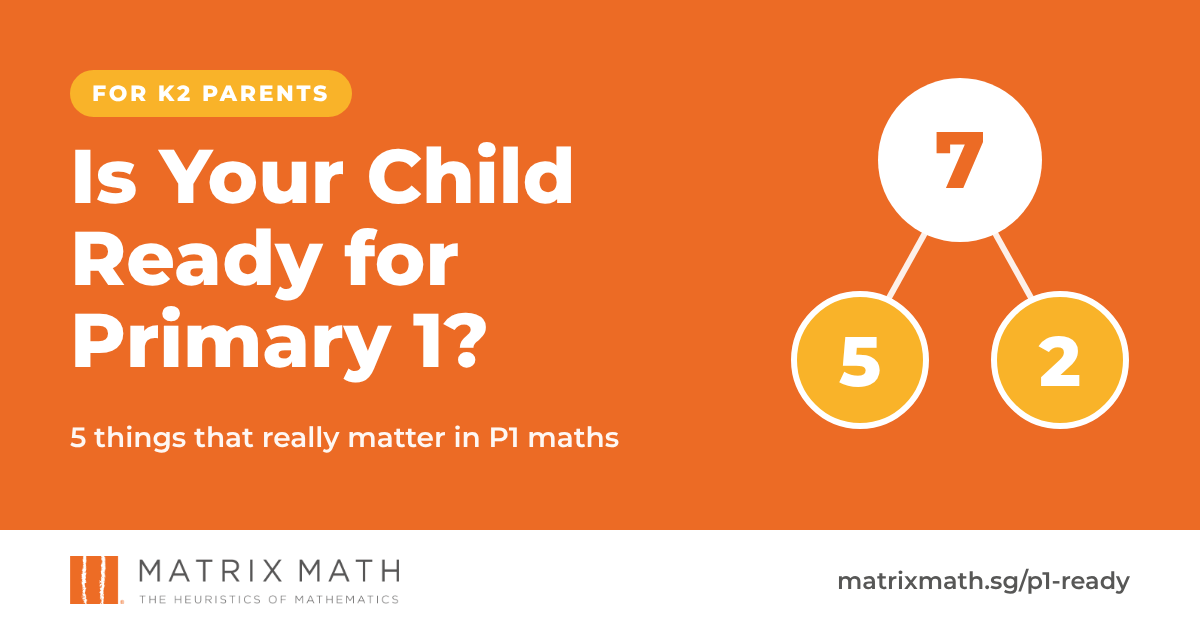
Not seeing that numbers can be broken up. One of the first big topics in P1 is number bonds: seeing that 7 can be 5 and 2, or 4 and 3. Children who only see 7 as "one number" find this hard, and number bonds are the base for nearly every addition and subtraction method that follows.
Reading the question. This surprises parents most. A child may know that 5 + 3 = 8, but get the word problem wrong because they don't understand "altogether", "left" or "how many more". In P1, maths is already partly a language test.
Writing numbers correctly. Writing 3, 5, 7 and 9 backwards is very common at this age and usually fixes itself. But a child who writes slowly or unclearly loses time on every worksheet, and that adds up.
Working alone. In kindergarten, a teacher is often sitting beside your child. In P1, there is one teacher for a full class. Children who can't sit and attempt a question on their own for five minutes tend to fall behind, even when they understand the maths.
Five quick checks you can do at home tonight
You don't need worksheets for these. A few sweets, some coins or a handful of Lego will do.
If your child manages most of these comfortably, they are in good shape. If two or more feel like a struggle, that's worth working on gently over the holidays. It is not a cause for panic.
A word of caution: don't over-prepare
This may sound strange coming from a maths enrichment centre, but please don't spend the December holidays drilling P1 assessment books.
A six-year-old who has done the whole P1 book before January often gets bored in class, stops listening, and then misses the method the teacher is building. Worse, a child who learns that maths means hours of worksheets can start to dislike it before school even begins.
Want a clearer picture? Try our free P1 readiness check
The home checks above give you a rough idea. If you want something more structured, we've built a free online test: Is Your Child Ready for Primary 1?
- About 20 short questions, done together with your child
- Covers basic number skills and simple problem solving, in line with the MOE syllabus
- Built from 18 years of teaching and watching how children actually learn maths
- A personalised report is emailed to you straight after, showing your child's strengths and the areas to work on
It takes about 15 minutes, and there is no obligation.
Start the free test →Matrix Math® has taught more than 31,500 students across 12 centres in Singapore since 2008.