19 May 2026
As the core foundation of mathematics, numbers are essential in early numeracy lessons. However, did you know that numbers can be categorised into various types, each playing a unique role in helping students solve maths problems and make sense of the world? In this article, we will discuss two of these number types: natural and whole numbers.
Natural numbers are also known as counting numbers, as we often use them to count and order everyday objects, whether with our hands or using other counting tools. Natural numbers start from 1, and they go up infinitely (1, 2, 3, 4, 5, and so on). By definition, natural numbers are positive integers and exclude negative numbers, fractions, decimals, and the number 0. They are also denoted with the letter N.
Natural numbers are a core part of basic arithmetic operations, including addition, subtraction, multiplication, and division. Early numeracy lessons, therefore, involve using natural numbers to represent quantities or to order them meaningfully.
Their set notation is as follows:
{1, 2, 3, 4, 5, …}
Whole numbers are similar to natural numbers, except that they also include 0. In this case, 0 is the smallest whole number, and it also goes up infinitely (0, 1, 2, 3, 4, and so on). Whole numbers are represented by the letter W, and, like natural numbers, they are also non-negative values that do not include fractions or decimals. They are used in situations where 0 is a meaningful quantity, such as measuring temperature, tracking financial transactions, or counting cookies in a jar.
As such, it is also possible to use whole numbers as part of various mathematical operations, including addition, subtraction, multiplication, and division. They are also important elements in more advanced mathematical concepts, such as algebra.
Their set notation is as follows:
{0, 1, 2, 3, 4, 5, …}
At first glance, the key difference between natural and whole numbers stems from the fact that natural numbers exclude the number 0, while whole numbers include it. Their primary notation also differs: natural numbers are denoted by N, while whole numbers are denoted by W. Both sets consist of positive integers that do not include decimals or fractions.
One aspect to remember is that while all natural numbers are whole numbers, not all whole numbers are natural numbers. In this case, natural numbers are a subset of whole numbers, while whole numbers are a superset of natural numbers. Again, this is because 0 is only considered a whole number.
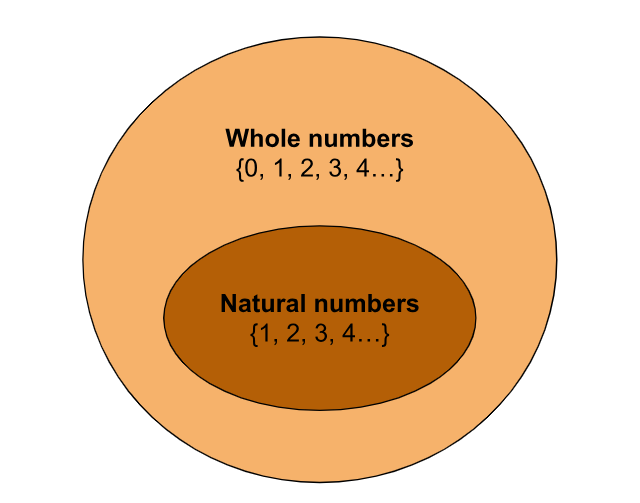
Consider this helpful summary comparing natural and whole numbers:
| Natural Numbers | Whole Numbers | |
|---|---|---|
|
Starting Point |
1 |
0 |
|
Representation |
N |
W |
|
Number Notation |
N = {1, 2, 3, 4, 5…} |
W = {0, 1, 2, 3, 4…} |
|
Includes Zero |
No |
Yes |
|
Purpose |
Counting and ordering |
Counting, ordering, representing quantities and zero values |
|
Overlap |
All natural numbers are whole numbers |
Not all whole numbers are natural numbers |
Both natural and whole numbers are solely made up of positive integers, not fractions or decimals. When students apply addition or multiplication to natural or whole numbers, the result is always a natural or whole number. However, there may be a few exceptions in certain mathematical operations.
By knowing the fundamentals of natural and whole numbers, students will have a better grasp of more advanced mathematical concepts they will learn in the future.
When performing specific mathematical operations on two natural or whole numbers, the result is always a natural or whole number.
2 + 5 = 7
0 × 3 = 0
This rule does not apply to subtraction or division, as students could end up with a negative number, a fraction, or a decimal as the final answer.
5 – 6 = -1
2 ÷ 4 = 0.5
The order in which two natural or whole numbers are added or multiplied does not affect the result.
3 + 2 = 5
2 + 3 = 5
However, this does not work in subtraction or division.
5 – 3 ≠ 3 – 5
Just like the commutative property, the grouping of numbers when adding or multiplying does not affect the final answer.
a +(b + c) = (a +b) + c
a ×(b ×c) = (a ×b) × c
This property does not apply to subtraction and division.
If students multiply a number by a sum or a subtraction:
a ×(b +c)
a ×(b -c)
They will then distribute the multiplication to each term before adding or subtracting the results, like this:
(a ×b) +(a ×c)
(a ×b) -(a ×c)
We can empower students’ understanding of natural and whole numbers using these simple exercises.
Consider the following series:
0, 5, 0.223, 12, 45, 76, 93, -12, 176, 49, 0.777, 8
Which of these are whole numbers, and which ones are natural numbers? Arrange these numbers in ascending order.
The Answer
Compare the following equations and determine whether they yield the same result.
11 × 6
6 × 11
The Answer
Using the rule of the commutative property, both equations lead to the same result.
11 × 6 = 66
6 × 11 = 66
Using the associative property, find a similar expression for the following:
2 × (4×5)
The Answer
Solving the original expression:
2 × (4×5) = 2 × (20) = 40
The equivalent expression is:
(2 × 4)×5 = (8) ×5 = 40
Thinking about augmenting your child’s primary Mathematics foundations? Contact us today to learn more about our personalised teaching methods tailored to individual student success!