
If you have watched your Primary 3 child work through a page of long division, you have probably seen the same thing happen more than once. They get the first few right. Then one goes wrong, and when you check the working you cannot tell where it broke. The next day they make a completely different mistake.
It is easy to conclude that your child is weak at maths. Usually that is not what is happening.
Long division is not one skill. It is four, and they arrive in the same lesson. Your child has to work out how many times the divisor fits, multiply, subtract, and bring the next digit down — while keeping every digit in the right column. Then, before that is secure, the questions turn into word problems, and two more skills arrive on top.
Most children do not fail long division because it is hard. They fail because too much arrived at once, and nobody separated it out.
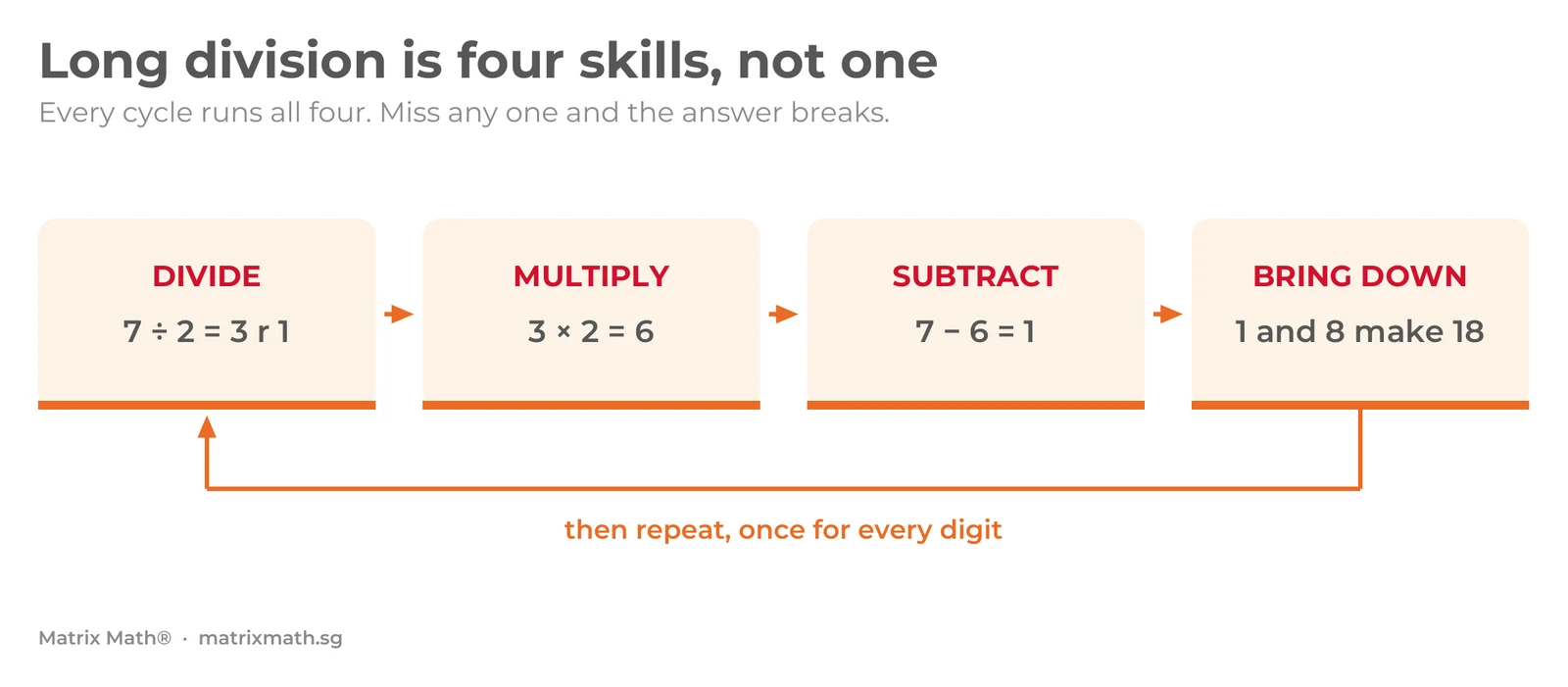
There is one thing that has to be in place first. Ask your child these three questions. Each answer should come back in about three seconds.
The second question is the one that catches people out. It is a multiplication fact read backwards, and long division only ever asks for it backwards. A child who can recite the four times table forwards but has to think about “how many 4s in 28” will lose their place halfway through a column.
If any of the three is slow, hesitant or wrong, work on that first. Long division will not fix it. It will hide it.
The instinct, when a child keeps getting long division wrong, is to give them more long division. More worksheets, more questions, more practice.
This rarely works, and the reason is simple. A mixed worksheet gives your child twenty questions that each require four skills. When they get one wrong, neither of you learns anything, because you cannot see which of the four broke. You mark it wrong, they try again, and the same thing happens next week.
What works is separating the skills, then testing them one at a time. That is what the nine worksheets below do. Each one introduces exactly one new idea and nothing else. When your child gets stuck, you know which rung they are standing on.
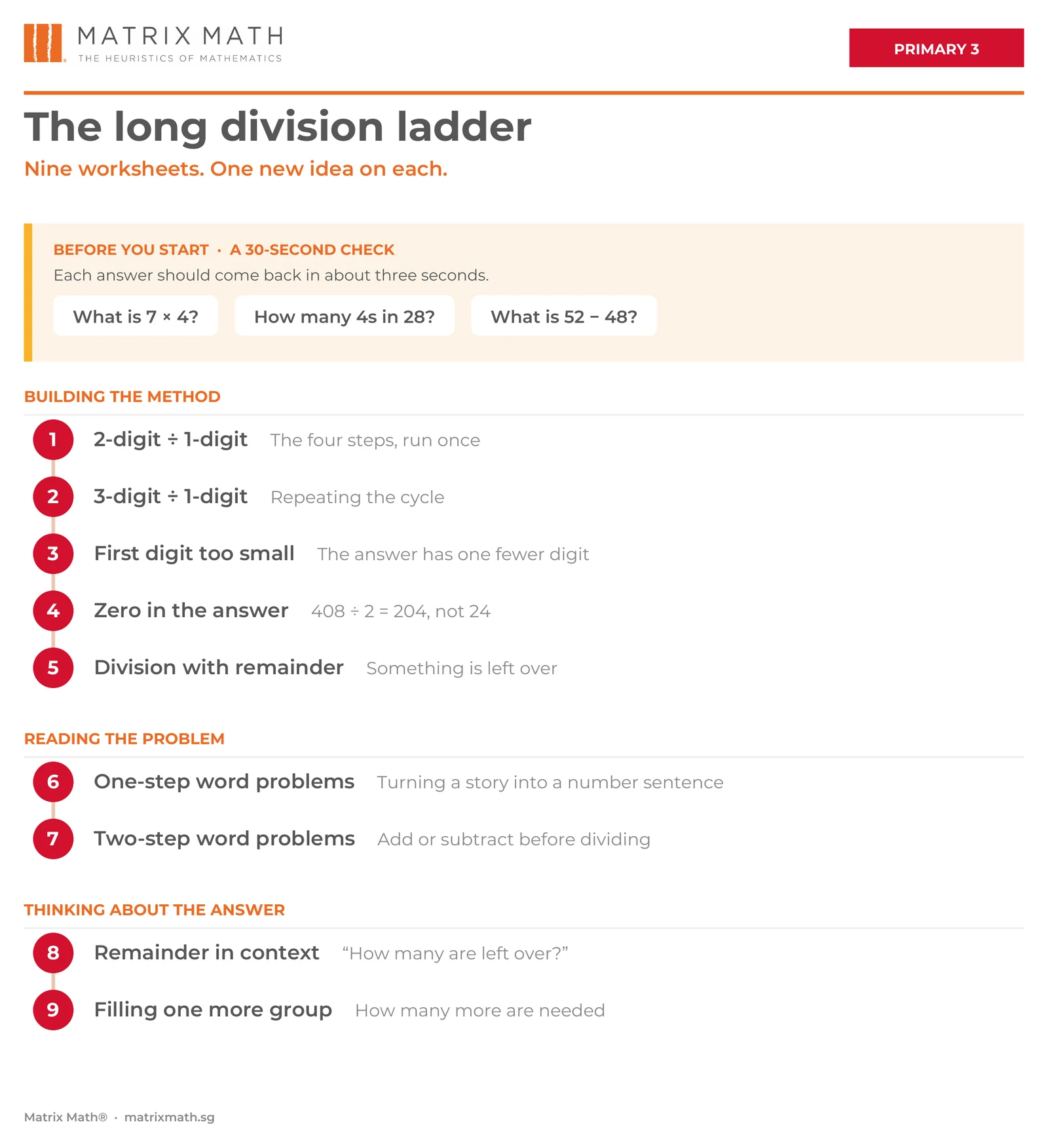
The whole method in a single cycle. Divide, multiply, subtract, bring down, and stop.
What goes wrong: the answer digit ends up in the wrong column, usually shifted one place left. Every answer digit must sit directly above the digit it came from.
Download Worksheet 1 — Two-Digit Division (PDF) ↓
Now the cycle runs three times instead of once, and your child has to hold their place while doing it.
What goes wrong: they run the cycle twice, then copy the last digit down instead of dividing it. A three-digit number needs the cycle three times, once for every digit.
Download Worksheet 2 — Three-Digit Division (PDF) ↓
In 213 ÷ 3, the 2 cannot be divided on its own. It joins the 1, and the answer has two digits instead of three.
What goes wrong: they force a digit above the 2 anyway and write 071, or put a 0 there. Nothing goes above that digit at all.
Download Worksheet 3 — First Digit Too Small (PDF) ↓
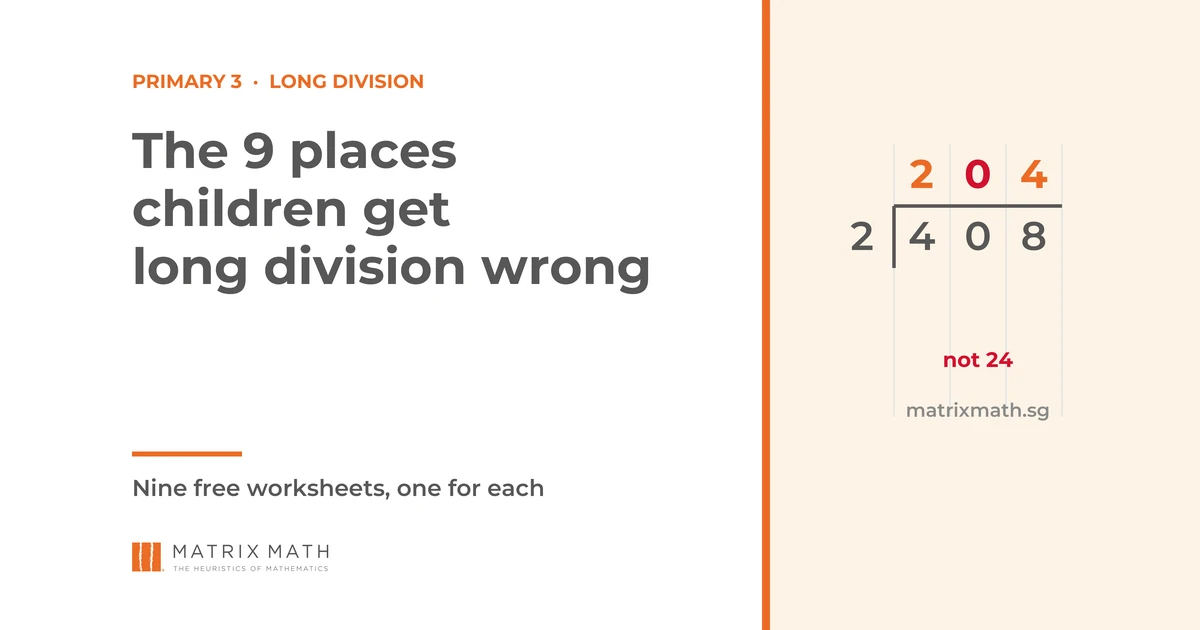
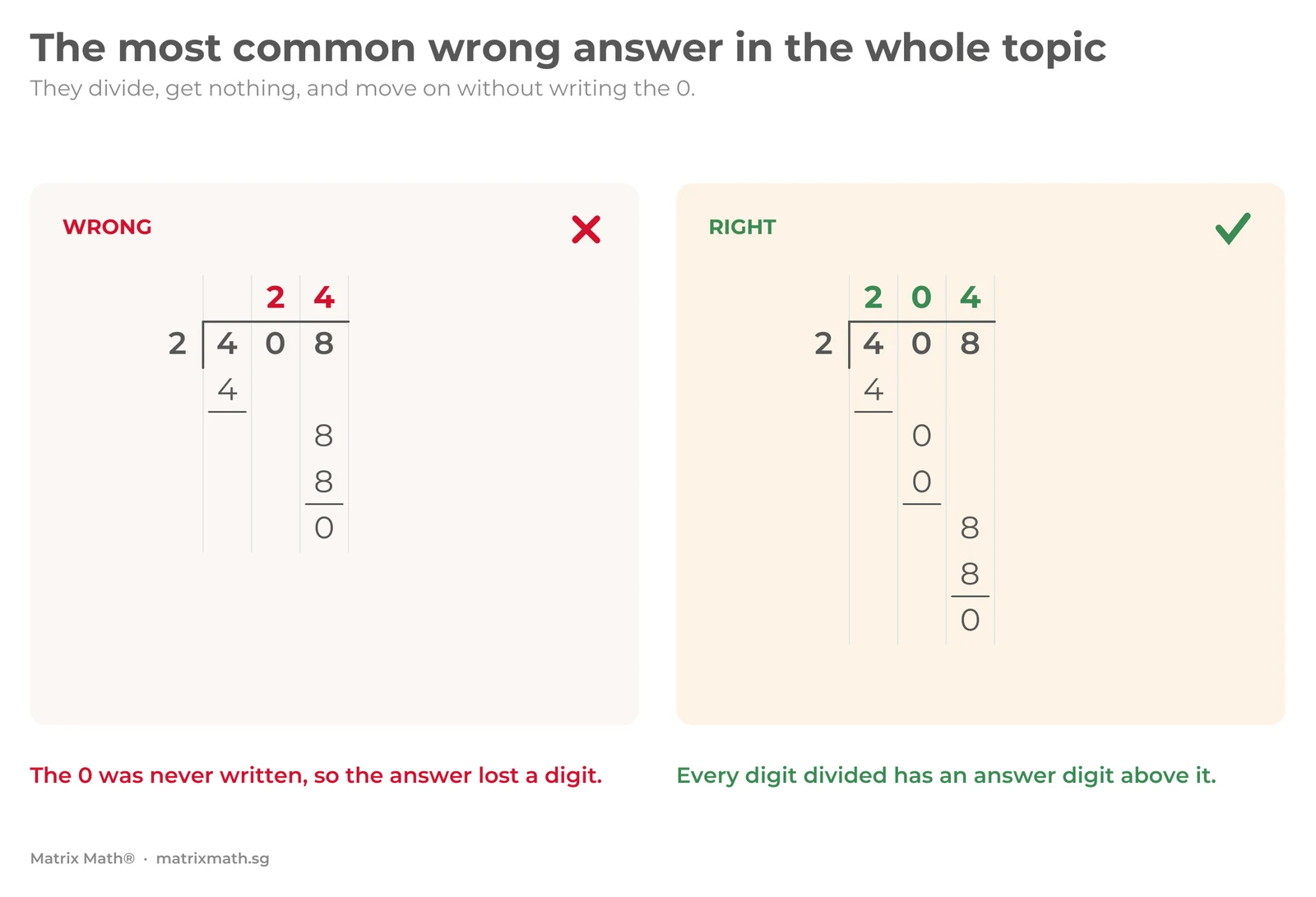
408 ÷ 2 = 204. Not 24.
What goes wrong: they divide, get nothing, and move straight on without writing the 0. This is the single most common wrong answer in the whole topic, and because it is usually mixed in among other questions, nobody notices it is a specific, fixable error.
Download Worksheet 4 — Zero in the Answer (PDF) ↓
Something is left over, and the answer stops being a single number.
What goes wrong: they leave a remainder bigger than the divisor — writing 5 R 6 for a division by 4. That always means the last answer digit was too small.
Download Worksheet 5 — Division with Remainder (PDF) ↓
Now they have to read a story and decide what to divide before any of the method matters.
What goes wrong: “shared with 3 friends” means four people, not three. They divide by the number of friends and forget to count the child doing the sharing.
Download Worksheet 6 — One-Step Word Problems (PDF) ↓
Add or subtract first, then divide.
What goes wrong: they divide the first number they see. Given 246 stamps and 132 more, shared into 3 albums, they divide 246 by 3 and never add the 132.
Download Worksheet 7 — Two-Step Word Problems (PDF) ↓
The division is ordinary. The question decides which half of the answer is wanted.
What goes wrong: asked how many are left over they give the number of groups, and asked how many groups they give the leftover. Same working, opposite answer.
Download Worksheet 8 — Remainder in Context (PDF) ↓
The hardest one, and the one that separates children who understand from children who have memorised.
What goes wrong: “packed into 4 bags” and “packed into bags of 4” look almost identical and need different methods. In the first, one full bag holds the answer to the division. In the second, one full bag holds 4. Children answer both the same way and get one wrong every time.
Download Worksheet 9 — Filling One More Group (PDF) ↓
Start at the beginning, even if it looks too easy. Worksheet 1 takes ten minutes for a child who is ready, and it tells you the foundation is solid. If they struggle, you have found the problem on day one instead of week three.
One worksheet per sitting. Each takes fifteen to twenty minutes. Nine worksheets is roughly three weeks at three sittings a week, which is the right pace for something that has to become automatic.
Mark the last question first. Every worksheet ends with a question that deliberately breaks the pattern the other questions have built. If your child got the first eight right and the last one wrong, they have been pattern-matching rather than thinking, and it is worth repeating that sheet.
Do not skip the answer key. Each one shows the full working, not just the final number. When something is wrong, the key tells you which step broke.
These nine worksheets divide by 2, 3, 4 and 5 only. That is deliberate — it keeps the focus on the method rather than on recall. By the end of Primary 3 your child also needs to divide by 6 through 9, and in Primary 4 the same method extends to four-digit numbers and two-digit divisors.
The method does not change. If the ladder is solid, everything after it is arithmetic.
If your child has worked through the ladder and is still going wrong in the same place, the problem is usually further back than long division. Working out where takes a teacher watching them do it, not another worksheet.
Bring the sheets your child struggled with to a Matrix Math® trial lesson. Our teachers will work through them with your child and show you exactly which rung the gap sits on. Book a trial lesson or call us on +65 6345 6439.
Long division is introduced in Primary 3, usually around age nine, under the MOE mathematics syllabus. Children divide two-digit and three-digit numbers by a one-digit number, first without remainders and then with them.
The times tables for the divisors being used, read both forwards and backwards, and subtraction across a ten. A child who can say “7 × 4 = 28” but has to think about “how many 4s in 28” is not ready yet.
Because nothing visibly happens at that step. They divide, get nothing, and move on without recording it. The fix is a counting rule: every digit of the dividend that was divided must have an answer digit directly above it.
Yes. It is part of the MOE Primary 3 syllabus and is assumed knowledge from Primary 4 onwards, including in PSLE questions.
For a child with secure times tables, roughly three weeks of short regular practice. For a child whose multiplication facts are not automatic, fix that first — otherwise the method will appear to be the problem when it is not.